
extraterrestrial intelligence, more advanced than us
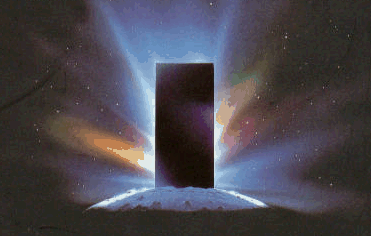
If other intelligent races exist in space, the chances are high that some of them will prove to be much more scientifically and technologically advanced than we are ourselves. The astonishingly rapid progress made, for instance, in the development of computers over the past few decades shows what dramatic strides can be achieved by a technologically ambitious race in a relatively short period of time. Given another century or so, humankind may have acquired capabilities in genetic engineering, nanotechnology, life prolongation, artificial intelligence, space propulsion, and other fields that, at present, we can barely imagine. As Arthur C. Clarke once wrote: "Any sufficiently advanced technology is indistinguishable from magic."
What would an alien race be like that was a thousand, or a million years, ahead of us? Would they have evolved so far in ways we cannot yet conceive that we would be as unaware of their presence and activities as ants are of human beings? One of the arguments sometimes put forward against the existence of advanced extraterrestrials is that if they were present we would have picked up signals from them by now. However, beings that are significantly ahead of us might lie beyond our communications horizon; that is, we may simply not have the means to tap into their conversations. A communications horizon of only 1,000 years might render us oblivious to 99.9% of the intelligent technological races in the Galaxy (see Drake Equation). Another argument is that advanced intelligence would leave clear visible signs of its existence – large-scale engineering projects in the Galaxy (see astroengineering) which would be the equivalent of bridges, highways, and skyscrapers on Earth, or, alternatively, a profusion of self-replicating spacecraft (see von Neumann probes). But this, again, assumes too much and is based on a parochial extrapolation from our own, present-day capabilities. For all we know, very advanced stellar and galactic engineering projects have the appearance of natural celestial objects, so that we may be looking straight at them without realizing their true nature. Or perhaps, more likely, the devices of highly evolved species are not dramatic and obvious, but are subtle and discrete so that they are simply undetectable from afar. It may be, for example, that instead of great starships, the most advanced races employ elevator-sized cubicles to "beam" themselves instantaneously to any point in the cosmos. Science fiction writers once envisioned future computers the size of planets. But, in fact, computers have shrunk in size and may soon be so small and adaptable that they will blend unnoticed into our environment.
Nor can we be sure of the general direction that other intelligent species might take in their development. We tend to measure progress and advancement on a scientific and technological scale – by the sophistication of our inventions and our knowledge of the physical universe. Yet there are and have been societies on Earth which have not given such high priority to the pursuit of rational understanding or the development of technology. In cultures that place more value on intuition, the direct experience of nature, spiritual fulfillment, and transcendental modes of awareness, a remarkably different view of the world seems to prevail. It may be that we shall encounter in the future alien races whose technological accomplishments are relatively modest but who have explored to depths beyond our comprehension the nature and potentialties of consciousness. It is difficult to come to terms with the possibility that despite all of our achievements we may still, comparatively speaking, be close to the bottom of the ladder of development.
There is also a difficulty for Western religions with the concept of aliens who may be more spiritually advanced than ourselves. This problem stems from a common assumption, made by many theologians, that God works through an historical process. As E. A. Barnes put it: "If God only realizes Himself within an evolutionary process, then elsewhere He has reached a splendor and fullness of existence to which Earth's evolutionary advance can add nothing."
The notion of a kind of cosmic spiritual ladder, on which we may be close to the bottom rung, provokes speculation about where our race, and others in the universe, may eventually be heading. This question has been addressed in science fiction by Olaf Stapledon in his Starmaker, Arthur C. Clarke in Childhood's End, Isaac Asimov in The Gods Themselves, and others. Both Stapledon and Clarke, for example, envisage a future union of individual sentient minds into a single "Overmind" (to use Clarke's term). A similar prediction of the emergence of a single cosmic super-being (essentially a conscious universe) stems from extreme speculation based on the anthropic principle.

