
gastrula
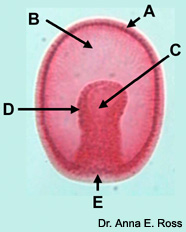
An echinoderm gastrula. It was formed by the invagination of blastomeres at the vegetal pole area of the blastula to produce the archenteron, which will become the digestive system. The opening into the archenteron is the blastopore, which will become the anus of the adult. The cavity of the archenteron is the gastrocoel. The roof of the archenteron, which forms the mesoderm, will expand and pinch off mesodermal vesicles with an internal cavity that will become the coelom (see: mesoderm). A - ectoderm; B - blastocoel; C - archenteron; D - endoderm; E - blastopore. (Photo: Dr. Anna E. Ross, Christian Brothers University, TN).
The gastrula is an embryo in the early stages of germ layer formation, immediately following the blastula stage. It consists of two cell layers, the ectoderm and the endoderm, formed by invagination and movement of cells in the single-layered blastula stage in the process of gastrulation. It contains a central cavity, called the archenteron, which opens to the outside via the blastopore. True gastrulation occurs only in the embryos of amphibians and certain fish, but a similar process occurs in the embryonic disk in other vertebrates, including humans.

