
infrared radiation
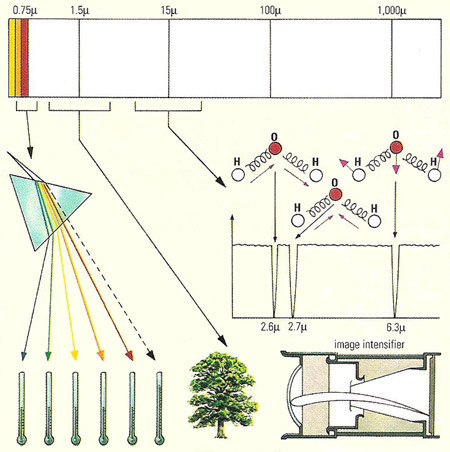
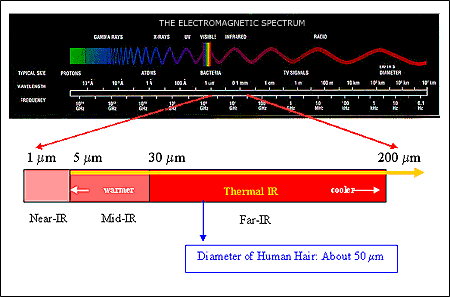
Infrared radiation is electromagnetic radiation of wavelengths longer than the red end of visible light and shorter than microwaves, extending roughly from 1 micron (10-6 meter) to 350 microns. Infrared is divided into three spectral regions – near, mid and far infrared – but the boundaries between these are not agreed upon and can vary. The main factor that decides which wavelengths are included in each of the regions is the type of detector technology used. A typical breakdown is shown in the table below.
The near infrared can be detected as heat, as discovered by William Herschel in 1800. He found that thermometer, placed beyond the red end of a spectrum produced by a prism, showed a rise in temperature. Near infrared has many uses, for example diagnosis of breast cancer and aerial surveying. Mid or intermediate infrared is used for chemical research to investigate molecular binding energies. When the molecular vibration is equal to the infrared frequency, resonance occurs. This can be detected by absorption spectroscopy. Infrared is also used in image intensifiers.
Very little of the infrared spectrum from space reaches to sea-level, although more of it can be observed by high-altitude aircraft, such as the SOFIA (Stratospheric Observatory for Infrared Astronomy), or telescopes on high mountaintops (such as the peak of Mauna Loa in Hawaii). See also infrared astronomy.
| infrared spectrum | |||
|---|---|---|---|
| spectral region | wavelength range (microns) | temperature range (K) | objects seen |
| near infrared | 1 to 5 | 740 to 3,000 | Cooler red stars, red giants, dust is transparent |
| mid infrared | 5 to 40 | 140 to 740 | Planets, comets and asteroids; dust warmed by starlight, protoplanetary disks |
| far infrared | 40 to 350 | 11.6 to 140 | Emission from cold dust; central regions of galaxies; very cold molecular clouds |

