
Kleinmann-Low Nebula
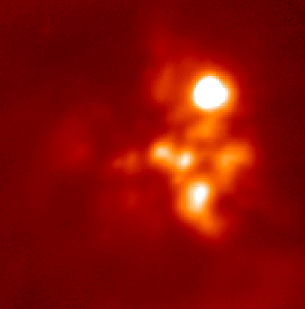
The Kleinmann-Low Nebula at 11.7 microns. The brightest source is the Becklin-Neugebauer object.
The Kleinmann-Low Nebula is a cool (less than 600 K), intense, extended infrared source that is the most active part of the Orion Complex; it lies about 1' northwest of the Trapezium and about 12 arcseconds south of the Becklin-Neugebauer Object and was discovered in 1967 by the American astronomers Douglas Kleinmann (1942–) and Frank Low (1933–2009). The Kleinmann-Low Nebula appears to consist of a cluster of young and forming stars embedded in a dusty molecular cloud. In visible light, the dust blocks much of the Nebula's light, but in infrared, at wavelengths less than 20 microns, the area region is bursting with activity. Hot stellar winds, flowing off massive young stars, permeate and heat surrounding gas, causing finger-like intrusions. Near the center of Kleinmann-Low is IRc2, a particularly active star with a mass estimated at more than 30 solar masses. A water maser (see interstellar maser) and concentrations of carbon monoxide (CO) have also been detected in association with the region.

