Larissa
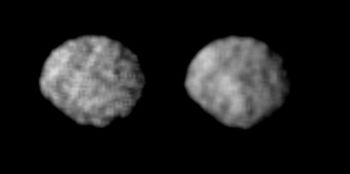
Larissa is the fifth moon of Neptune in order from the planet. It was discovered in 1981 by the American space engineer Harold Reitsema and his colleagues from ground-based stellar occultation observations, although the first (and so far only) images of it were obtained in 1989 by Voyager 2. Larissa is named after a lover of Poseidon (Neptune) in Greek mythology and is also known as Neptune VII.
Like the five other inner moons of Neptune studied during Voyager's flyby, Larissa is among the darkest objects in the solar system. It is irregular in shape and appears to be heavily cratered. Theory suggests that Larissa, along with the other satellites inward of Triton, is a rubble pile re-accreted from fragments of Neptune's original satellites, which were smashed up by perturbations from Triton soon after that moon's capture into an eccentric initial orbit.
| discovery | 1981, Reitsema et al |
| semimajor axis | 73,548 km (45,710 m) |
| diameter | 216×204×164 km (134×127×102 mi) |
| orbital period | 0.555 days (13 h 19 min) |
| orbital eccentricity | 0.0014 |
| orbital inclination | 0.25° |
| visual albedo | 0.09 |