
Mercury-Redstone
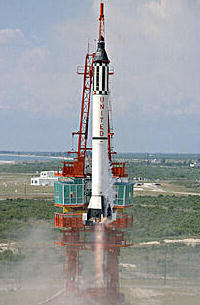
Launch of Shephard's Freedom 7.
Mercury-Redstone was a modified version of the Redstone missile used in NASA's initial effort to launch astronauts into space. In most respects, the Mercury-Redstone was similar to its missile relative. In fact, the vehicle was selected for the Mercury Project because of its proven track record of safety and reliability. The Mercury-Redstone incorporate additional safety features, as well as an upgraded Rocketdyne engine. About 800 engineering changes were also made to the production version of the Redstone to qualify it as a manned space launch vehicle. These included extending the fuel tank by about 2 m to increase the burn time and thus achieve increased speed and altitude.
Alan Shepard, the first American astronaut, was launched aboard a Mercury-Redstone from Cape Canaveral Launch Pad 5 on 5 May 1961, on mission MR-3. A nearly identical flight designated MR-4 carried Virgil Grissom on 21 July 1961. Mercury-Redstone mission performance in support of suborbital manned flights MR-3 and MR-4 was so successful that two similar flights which would have been designated MR-5 and MR-6 were cancelled.
| length | 25.5 m |
| diameter | 1.8 m |
| thrust | 348,000 newtons |

