
microtubule
A microtubule is a slender, hollow, cylindrical filament found in the cytoskeleton of animal and plant cells. Microtubules not only provide a structural network within the cell's cytoplasm but also form a substrate on which other cellular chemicals can interact, are used in intracellular transport, and are involved in cell motility.
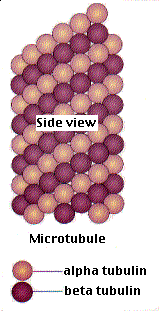 |
Composed of the protein tubulin, microtubules have a diameter of about 25 nanometers and a variable length that may be up to 1,000 times as great as the diameter. They are built by the assembly of dimers of alpha tubulin and beta tubulin, growing at each end by the polymerization of tubulin dimers (powered by the hydrolysis of GTP) or shrinking at each end by the release of tubulin dimers (depolymerization). Both processes always occur more rapidly at one end, called the plus end, than the other, called the minus end.

