
Newton's orbital cannon
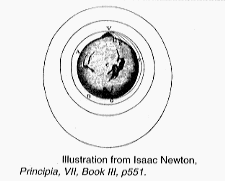
Isaac Newton discussed the use of a cannon to place an object in orbit in his Principia Mathematica (1687) – the book that defined classical physics and provided the theoretical basis for space travel and rocketry. Newton used the following thought experiment to explain the principle of Earth orbits. Imagine a mountain so high that its peak is above Earth's atmosphere; on top of this mountain is a cannon that fires horizontally. As more and more charge is used with each shot, the speed of the cannonball will be greater, and the projectile will fall to the ground farther and farther from the mountain. Finally, at a certain speed, the cannonball will not hit the ground at all but will fall toward the circular Earth just as fast as Earth curves away from it. In the absence of drag from the atmosphere, it will continue forever in Earth orbit.

