
nebula filter
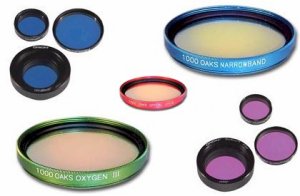
A selection of nebula filters.
A nebula filter is a special type of filter made so as to enhance the contrast of many nebulae and thereby enable the observer to see nebulae that are otherwise not very visible in light-polluted locations; they can also enhance the visibility of some nebulae even at very dark observing sites. Nebula filters are manufactured with vacuum-deposition technology to create coatings that transmit very specific wavelength regions and block the rest of the visible spectrum to increase contrast for certain nebulae.
Narrowband nebula filters, commonly called ultra high contrast (UHC) filters, pass the hydrogen-alpha, hydrogen-beta, and oxygen-III spectral wavelengths and block the rest of the visible spectrum; O-III filters pass only the oxygen-III wavelength. (Since stars are broadband emitters these filters will not help in viewing stars, star clusters, or galaxies – indeed, they will just make those objects more dim.)
A third type of filter called an H-beta blocks all light but the hydrogen-beta wavelength and is only useful for a few specific nebulae, such as the Horsehead Nebula, California Nebula, and Cocoon Nebula, that strongly emit in this line. Finally, there is the LPR (light pollution reduction) filter – a broadband filter intended to mitigate the effect of common light pollution sources such as street lights.

