
open cluster

The open cluster M39 in Cygnus. It lies about 800 light-years away and contains stars that are only about 300 million years old. Image: WIYN telescope, Kitt Peak.
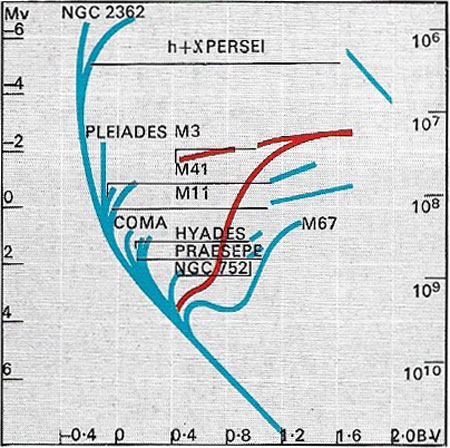
The color-magnitude graph of open clusters shows absolute magnitude Mv against color index (B-V = photographic magnitude minus visual magnitude). The age, in years, is given on the right-hand scale..
An open cluster is a loose aggregation of dozens or hundreds of young stars, in a volume of space typically less than 50 light-years across. Open clusters are only weakly held together by gravity and are fated to disperse over a period, typically, of several hundred million years. Some much older open clusters are known, however. For example, M67 in Cancer, which lies about 2,800 light-years away, is at least 4 billion years old but is located well away from the galactic plane and as a result is less liable to disruption.
An older name for these groupings is galactic clusters because they are found mostly in the disk, and especially the spiral arms, of this and other disk galaxies.
The stars in open clusters have formed together within the same interstellar cloud; indeed, in many diffuse nebulae, the birth of new open clusters can be seen taking place. As open clusters drift along, some of their members escape due to velocity changes in mutual closer encounters, tidal forces in the galactic gravitational field, and encounters with field stars and interstellar clouds passing their way.
Well known examples of open clusters include:
Pleiades
Hyades
Praesepe
Butterfly Cluster
Ptolemy's Cluster
Wild Duck Cluster
NGC 752
Compare with globular clusters.

