
2 Pallas
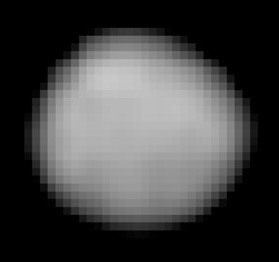
Hubble Space Telescope image (using UV filter) of Pallas obtained in 2007.
2 Pallas is the second largest asteroid and the second to be discovered, by Heinrich Olbers in 1802. It is slightly irregular in shape and appears to have the same composition as meteorites classed as low-grade carbonaceous chondrites or enstatite achondrites. With a maximum visual magnitude of 8.0, it is only ever outshone by Vesta and Ceres.
| diameter | 570 × 525 × 482 km |
| density | 3.4 g/cm3 |
| albedo | 0.05 |
| rotational period | 9 to 12 hours |
| semimajor axis | 2.773 AU |
| perihelion | 2.136 AU |
| aphelion | 3.409 AU |
| eccentricity | 0.230 |
| inclination | 34.85° |
| period | 4.62 years |

