
617 Patroclus
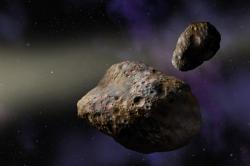
Artist's rendering of how the Patroclus binary pair might appear. (Image: Keck Observatory/Lynette Cook).
617 Patroclus was the second Jovian trojan to be discovered, by August Kopff in 1906. Patroclus lies at Jupiter's trailing Lagrangian point (L5). It is the only trojan of Jupiter in the "Trojan camp" to be named after a Greek character because the naming conventions for the Trojan asteroids were not adopted until after Patroclus was named.
In 2001 it was discovered that Patroclus is actually a binary asteroid. The larger component retains the name Patroclus while the smaller has been named Menoetius, with the provisional designation S/2001 (617) 1.
In January 2006 it was announced that Patroclus and Menoetius are more likely to be dirt-covered ice balls than rocky rubble piles, as previously supposed. This interpretation supports a theory put forward in 2005 that the Trojans are effectively frozen comets captured by Jupiter some 650 million years after the giant planets formed.1
| diameter | 105 km |
| density | 0.8 g/cm³ |
| albedo | 0.047 |
| rotational period | 40 hours |
| semimajor axis | 5.228 AU |
| perihelion | 4.506 AU |
| aphelion | 5.950 AU |
| eccentricity | 0.138 |
| inclination | 22.03° |
| period | 11.95 years |
| other designations |
1906 VY, 1941 XC, and 1962 NB |
Reference
1. Marchis, F., et al. "A low density of 0.8 g cm-3 for the Trojan binary asteroid 617 Patroclus." Nature, vol 439, p 563, 2006.

