
Pegasus (launch vehicle)
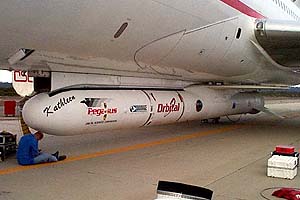
Pegasus XL.
Pegasus is an air-launched space launch vehicle, developed by Orbital Sciences Corporation, that works in a similar way to an air-launched ballistic missile (ALBM). Like an ALBM, Pegasus is dropped from an aircraft and fires its rocket seconds later. But instead of completing a ballistic trajectory to carry a weapons payload to its target, Pegasus carries a payload into space.
The original vehicle, now referred to as the Pegasus Standard, has been superceded by the Pegasus XL which is available in three- or four-stage versions. There are two fourth-stage options. The Hydrazine Auxiliary Propulsion System (HAPS), which burns hydrazine liquid fuel, provides precision orbital insertion capability for the payload. Alternatively, the fourth stage can be powered by a Thiokol Star 27 solid rocket motor, which burns HTPB solid fuel and can provide Earth-escape trajectory capability for the payload. The Pegasus XL employs a standard payload fairing, 2.1 meters long with a diameter of 1.1 meters. This fairing is able to accommodate one payload in a dedicated launch configuration or two payloads in a shared launch configuration.
In a typical mission profile without a fourth stage, the Pegasus XL is dropped over open water from a customized L-1011 aircraft flying at an altitude of 11,600 meters. The drop is considered to be the actual launch, although the first stage is not fired until five seconds later at an altitude of 11,470 meters. The rocket employs an inertial guidance system to pitch it upward after first stage ignition. The first stage burns out 77 seconds after launch, and is jettisoned. The second stage is fired 95 seconds after launch, followed by separation of the payload fairing at 111 seconds after launch. The second stage burns out 168 seconds after launch, at which time the second and third stage combination begin an unpowered coast period. During this coast period, the second stage remains attached to provide aerodynamic stability. Ultimately, the spent second stage is jettisoned and the third stage is fired 592 sec after launch. The third stage burns out 657 seconds after launch and is jettisoned from the payload, having successfully inserted it into orbit. The Pegasus XL can deliver a payload of 450 kilograms to low Earth orbit, or place 125 kilograms on an Earth-escape trajectory.
Pegasus
• World's first privately developed space launch vehicle
• Maiden 1990 mission marked the first all-new, unmanned space launch vehicle developed in the US in more than 20 years
• First winged vehicle to accelerate to eight times the speed of sound
• First air-launched rocket to place satellites into orbit, using its carrier aircraft as an "air breathing reusable first stage"
| stages (Pegasus XL) | first | second | third |
| engine designation | Orion 50SXL | Orion 50XL | Orion 38 |
| length (m) | 10.3 | 3.1 | 1.3 |
| diameter (m) | 1.3 | 1.3 | 0.97 |
| fuel | HTPB | HTPB | HTPB |
| thrust (N) | 726,000 | 153,000 | 32,000 |

