
Pleione (28 Tauri)
Pleione (28 Tauri), named after the mother to Taurus's Pleiades, is the seventh brightest among the named stars of the cluster, just behind the Pleiades' mythical father, the god Atlas. All nine are hot class B stars, their blue-white similarity giving the cluster so much of its sparkle. Pleione and Sterope are the coolest of them and also the only dwarfs; the others are either subgiants like Merope or giants like Alcyone.
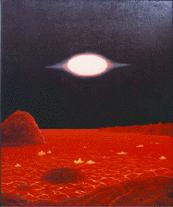 |
| Pleione as portrayed by the artist Chesley Bonestell.
© Bonestell Space Art, used with permission
|
Along with Gamma Cassiopeiae, Pleione is one of the classic Be stars of the sky. A Be star's emissions come from a surrounding ring of gas that is somehow related to the star's great rotation speed, Pleione spinning at least as fast as 329 kilometers per second at the equator, 165 times faster than the Sun, giving it a rotation period of under half a day. The emissions of Be stars are split by the Doppler effect as a result of one part of the ring rotating toward us, the other receding. In the extreme shell star case, the ring also produces absorptions from both hydrogen and from a variety of elements caused by the ring directly blocking starlight. The difference in Be star styles was once thought to be a matter of orientation, but Pleione puts the lie to the theory by switching among all three phases, normal B star, Be star, Be shell star, the changes taking place at intervals of 17 and 34 years. These changes are related to brightness variations (which gave Pleione the variable star name BU Tauri). As the star enters the shell phase it fades by several tenths of a magnitude, the latest episode occurring in 1970. The switches may be related to the effect of a binary companion (about which nothing is known) that orbits eccentrically with a 35-year period and averages 28 astronomical unitsfrom Pleione proper: but no one really knows.
Pleione was seen to develop to a shell or envelope twice in the 20th century: the first in 1938, which reached a peak brightness in 1945, then faded, and a second in 1972.
| visual magnitude | 5.05 |
| absolute magnitude | -0.33 |
| spectral type | B7V |
| distance | 387 light-years |
| position | RA 03h 49m 11.2s, Dec +24° 08' 12" |

