
Poe, Edgar Allan (1809–1849)
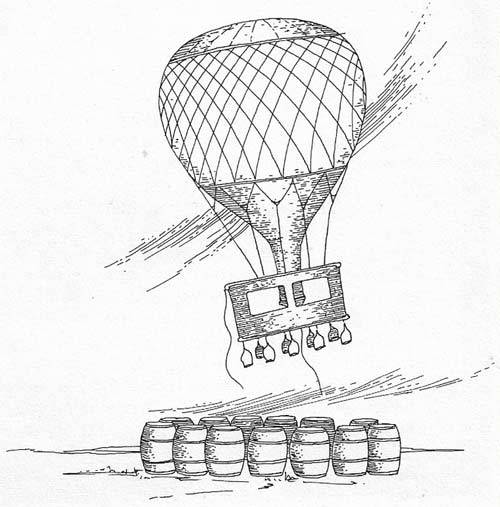
Hans Pfaal, hero of a story by Edgar Allen Poe, fled from the Earth in a homemade balloon because he was heavily in debt. He took off from Rotterdam, carrying an air condenser so he could breathe the rarefied air in space.
Edgar Allan Poe was an American short-story writer, poet, critic, and pioneer of the mystery and science fiction genres. His The Unparalleled Adventure of One Hans Pfaal (1835) ranks among the first scientifically serious tales of spaceflight and had a powerful influence on future writings on this subject. His description of Earth as seen from space is surprisingly accurate and his sealed gondola-ship reminiscent of stratospheric balloons of the 1930s. It is no coincidence that one of his university teachers was Joseph Tucker.
 |
The plot of Hans Pfaal
Pfaall's reason for going to the Moon was hardly romantic; he was broke and heavily in debt, and the only way out was to flee the Earth. Pfaall built a balloon, not forgetting "an apparatus for the condensation of the atmospheric air to provide air for breathing as he passed through what he assumed was a rarified atmosphere extending to the Moon. The takeoff from Rotterdam at seemed uneventful: "[I] was pleased to find that shot I upward with inconceivable rapidity (upon cut ting the attachment cord), carrying with all ease hundred and seventy-five pounds of leaden ballast." Presently, however, he had some trouble with kegs of gunpowder that gave the balloon an unexpectedly great jolt.
a concussion . . . burst abruptly . . . and seemed to the very firmament asunder . . . . The balloon at collapsed, then furiously expanded, then whirled and round with sickening velocity, and finally, reeling staggering like a drunken man, hurled over the rim the car, and left me dangling, at a terrific height, my head downward, and my face outward, by a of slender cord about three feet in length.
But Hans finally managed to pull himself back in the balloon. As the balloon progressed Moonward, Hans's air condenser failed to work, but after experiencing bad moments he was able to put it in working order_ He averaged about one thousand miles a day, and by the eighth day he was so distant that "not even the outlines of the continents could be seen." Hans settled down to what had become a routine trip.
Seventeen days out of Rotterdam catastrophe struck. The balloon burst. "I was falling, falling with the most impetuous, the most unparalleled velocity. Convinced he was falling back to Earth, Hans Pfaal braced himself for annihilation. But he found that the Earth "was over my head and completely hidden by the ballon, while the moon . . . the moon itself in all its glory – lay beneath me and at my feet." Hans dumped all his ballast and even cut the balloon car loose, and presently settled gently down in the middle of a Lunar city populated by crowds of "ugly little people." After spending five years with the Lunarians, he sent one of them to Earth in his reconstructed balloon to ask forgiveness of his debts. Alas, the two-foot-high Lunarian was so afraid of the denizens of Earth that he did not wait for an
answer. Hans was doomed to remain forever on the Moon, a debtor in exile.
Poe's other work
Poe is probably best known for his stories of the macabre. But, with the publication of "The Murders in the Rue Morgue" (1841), he also became the father of the modern detective story. Poe's poem "The Raven" (1845) ranks as one of the most widely read poems in American literature. Among his better-known short stories are: "The Gold Bug" and "The Masque of the Red Death" (1842), "The Pit and the Pendulum" and "The Tell-Tale Heart" (1843), "The Premature Burial" (1844), and "The Cask of Amontillado" (1846). His novel The Fall of the House of Usher (1842) also sets a standard for macabre fiction. Poe, who is known to have drunk heavily and used drugs, died ignominiously in a ditch in Baltimore, Maryland, after a heavy drinking spree.
Reference
1. Poe, Edgar Allan. "The Unparalleled Adventure of One Hans Pfaal." In Works of Edgar Allen Poe, edited by J. H. Ingram. Edinburgh: A. & C. Black, 1875.

