palindrome
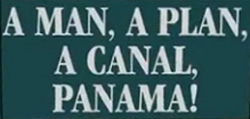
One of the best and best-known palindromes.
A palindrome is a word, verse, sentence, or passage that reads the same forwards or backwards; the term comes from the Greek palindromos for "running back again." Well-known examples include: "Madam, I'm Adam;" "A man, a plan, a canal – Panama!;" and "Able was I ere I saw Elba." A slightly longer one, devised by Peter Hilton, a code-breaker on the British team that cracked the German Enigma, is "Doc, note. I dissent. A fast never prevents a fatness. I diet on cod."
Credit for inventing the palindrome is often given to Sotades the Obscene of Maronea (3rd century BC). Though only eleven lines of his work have survived, he is thought to have recast the entire Iliad in palindromic verse. Sotades also wrote lines (now sometimes called Sotadic verses) that, when read backwards, had the opposite meaning. His acid tongue eventually landed him in jail by order of Ptolemy II, though worse was to follow. Sotades escaped but was captured by Ptolemy's admiral Patroclus, who sealed him in a leaden chest and tossed him into the sea.
A musical palindrome is formed by Haydn's Symphony No. 47 in G, sometimes referred to as The Palindrome, because in both the minuet and the trio the orchestra plays the music twice forwards and then twice backwards to arrive at the beginning.