
plasmid
A plasmid is a small fragment of extrachromosomal DNA, usually circular, that replicates independently of the main chromosome, although it may have been derived from it. Plasmids make up about 5 percent of the DNA of many bacteria but are relatively rare in eukaryotic cells. They carry information that give bacteria resistance to antibiotics. They are often used in genetic engineering as cloning vectors to carry desired genes into organisms.
Plasmids have a molecular weight of 1–5 × 10⁷ daltons and may contain enough genetic information to code for about 100 genes.
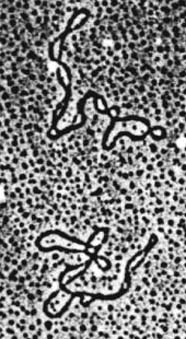 |
| A supercoiled plasmid is the predominant in vivo
form in which the plasmid is coiled around histone-like proteins.
Supporting proteins are stripped away during extraction from the bacterial
cell, causing the plasmid molecule to supercoil around itself in vitro.
Photo credit: Stanley Maloy, Director, Center for Microbial Sciences,
San Diego State University
|

