
plutoid
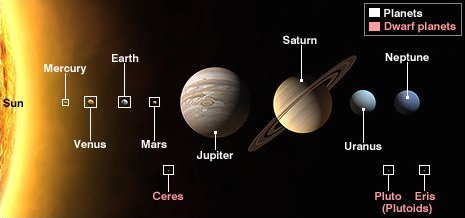
Planets, dwarf planets, and plutoids. Credit: BBC.
A plutoid is any dwarf planet that orbits beyond the orbit of Neptune. Currently only two known objects fall into this subcategory, Pluto and Eris, although many more plutoids may be awaiting discovery in the Kuiper Belt.
The subcategory plutoid was defined by the International Astronomical Union's Committee on Small Body Nomenclature in Jun 2008. According to an earlier (2006) definition of the IAU, dwarf planets are objects that "have sufficient mass for their self-gravity to overcome rigid body forces so that they assume a hydrostatic equilibrium (near-spherical) shape, and that have not cleared [their orbits of debris]." This definition includes the largest asteroid Ceres. However, only Pluto and Eris meet the further criterion that a plutoid has an orbit that takes it further from the Sun than Neptune.

