
resolution
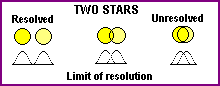
The Rayleigh criterion shows that the minimum angular spread that can be resolved by an image forming system is limited by diffraction to the ratio of the wavelength of the waves to the aperture width. For this reason, high resolution imaging systems such as astronomical telescopes, long distance telephoto camera lenses and radio telescopes have large apertures. The use of interferometers and new techniques such as adaptive optics has allowed dramatic improvements in resolving power.
Spectral (or frequency) resolution is the ability of a telescope to differentiate two light signals that differ in frequency by a small amount. The closer the two signals are in frequency while still allowing the telescope to separate them as two distinct components, the greater the spectral resolution of the instrument.
Resolving power
Resolving power is the ability of an imaging device to separate (i.e., to see as distinct) points of an object that are located at a small angular distance or it is the power of an optical instrument to separate far away objects, that are close together, into individual images. The term resolution or minimum resolvable distance is the minimum distance between distinguishable objects in an image, although the term is loosely used by many users of microscopes and telescopes to describe resolving power. Diffraction-limited resolution is defined by the Rayleigh criterion as the angular separation of two point sources when the maximum of each source lies in the first minimum of the diffraction pattern (Airy disk) of the other.

