
Serviss, Garrett (Putnam) (1851–1929)
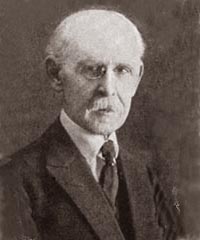
Garrett Serviss was an American journalist and writer of popular astronomy fiction and non-fiction, with a science major from Cornell University, who, in his Other Worlds (1901),1 draws upon Laplace's nebular hypothesis and Darwinian biology in arguing the case for varying degrees of habitability and evolutionary progress on the planets of the solar system. Mercury is uninhabitable by life as we know it, whereas Venus he suggests may be:
... passing through some such period in its history as that at which the earth had arrived in the age of the carboniferous forests, or the age of the gigantic reptiles ...
Since Mars, according to the Laplacian scheme of planetary evolution, formed and cooled earlier than the Earth, its inhabitants were biologically older and possessed of "superhuman powers," as evidenced by the canals in which Serviss believed. The outer planets, he concluded, were sunlike bodies that are burned out and are still in the process of becoming worlds. His fictional tales include a sequel to Well's The War of the Worlds, called Edison's Conquest of Mars (1898),2 and A Columbus in Space3 (1909) published in All-Story Magazine, which portrays Venus as having progressed well beyond the Carboniferous stage and become populated by two tribes, one subhuman and the other human.
 |
References
1. Serviss, Garrett P. Other Worlds, Their Nature, Possibilities and
Habitability in the Light of the Latest Discoveries. New York (1901).
2. Serviss, Garrett P. Edison's Conquest of Mars. Reprinted Carcosa
House (1947).
3. Serviss, Garrett P. A Columbus in Space. Westport, Conn.: Hyperion
Press (1974) (first published 1909).

