TransHab
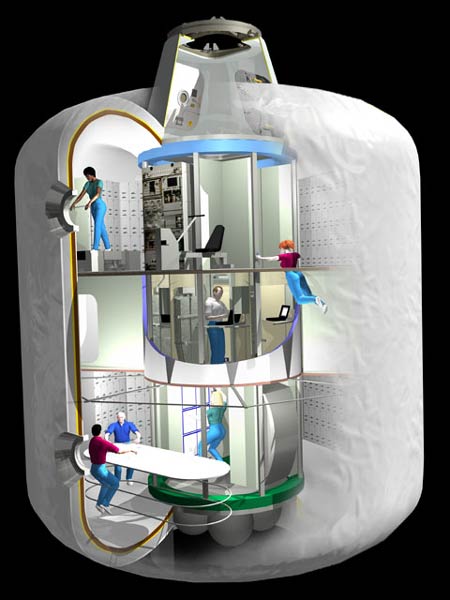
Cutaway view of Transhab concept. Credit: NASA.
TransHab is a concept pursued by NASA to develop the technology for inflatable habitats in space. The design was tested at the agency's Johnson Space Center and mooted as an alternative to the "hard" habitation modules used for the International Space Station (ISS). Although the project was abadoned due to budget cuts in 2001, Bigelow Aerospace of Las Vegas, Nevada – a nascent space tourism company owned by hotelier Robert Bigelow – purchased the rights to the patents developed by NASA and is now pursuing a similar scheme for a civilian space station.
Bigelow Aerospace had reserved slots on two Russian Dnepr rockets in order to launch a scaled-down prototype of the company's inflatable space habitat, called the Genesis Pathfinder module, into low-Earth orbit in the secnd half of 2006. The full-size version is expected to provide 330 cubic metersof living space with a 30-centimeter-thick multilayered polymer and Kevlar hull to protect against space debris. The one-third-size prototype will in part be testing the ability of the compacted form to expand like a concertina when deployed.