
Tycho's Star
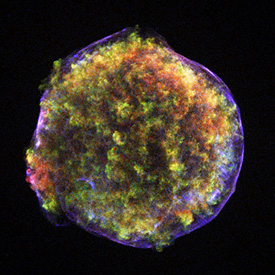
X-ray view of Tycho's supernova remnant. Credit: NASA/CXC/Rutgers/J.Warren & J.Hughes et al.

Location in the Milky Way of historic supernovas. This artist's impression shows a view looking down on the Milky Way Galaxy. The position of the Sun is shown, as are the approximate positions and names of historical supernovas, including Tycho's Star. These are stellar explosions that are thought to have occurred in the last 2,000 years and may have been seen by early astronomers. Credit: NASA/CXC/M.Weiss.
Tycho's Star was a Type Ia supernova in the constellation Cassiopeia (also known by its variable star name B Cassiopeiae), that was observed and described by Tycho Brahe in November 1572. At its peak it was as bright as Venus and was visible in the daytime, reaching a magnitude of about –4.
The present supernova remnant, which lies about 8,000 light-years away, is associated with some faint optical nebulosity, the intense radio source 3C 10, and the weak X-ray source 2U 0022+63.
X-ray observations of Tycho's supernova remnant by the Chandra X-ray observatory have revealed a puzzling anomaly. According to conventional models of supernovae remnants, the forward shock wave from Tycho ought to have moved about 2 light-years (12.5 trillion miles) ahead of the debris field. However, Chandra scientists have found that the shock wave and debris field are separated by only half a light year. For some unknown reason, either the front wave has lost a surprising amount of its strength or the following debris field is traveling much faster than expected.
Companion of Tycho's Star
Tycho's Star is one of two Type Ia supernovae to have been observed in our Galaxy over the past few hundred years, the other being Kepler's Star. Such an event is thought to arise when a white dwarf accretes matter from a companion star, is compressed, and undergoes a thermonuclear explosion. Unless the companion star is another white dwarf (in which case it should be destroyed by the mass-transfer process itself), it should survive and show distinguishing properties. At the same distance as Tycho's Star has been found a type G0–G2 star, similar to the Sun in surface temperature and luminosity (but lower surface gravity), moving at more than three times the mean velocity of the stars at that distance, which may be the companion.

