
trapezius
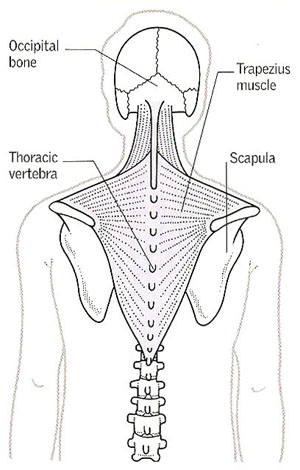
Trapezius, simplified diagram.
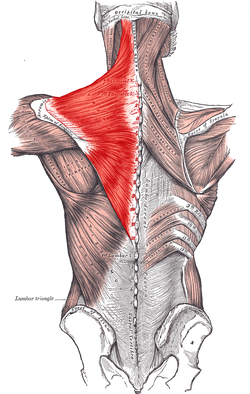
Trapezius and other muscles of the shoulder, neck, and back, from Gray's Anatomy (1918).
The trapezius is a large, diamond-shaped muscle that extends from the back of the skull down to the lower part of the spine in the chest and across the width of the shoulders. The trapezius is attached to the top and back of the scapula (shoulder blade) as well as to the outer part of the clavicle (collarbone). Its function is to help support the neck and spine; it is also involved in moving the arm.
The trapezius muscle suspends the shoulder girdle from the skull and spinal
column. The upper fibers elevate the scapula. The middle fibers retract
the scapula. The lower fibers pull the medial border of the scapula downward
so that the glenoid cavity faces
upward and forward. Knowing that the scapula rotates around the point of
attachment of the coracoid process to the clavicle by the coracoclavicular
ligament, it can be appreciated that the superior and inferior fibers of
the trapezius assist the serratus
anterior muscle in rotating the scapula when the arm is raised above
the head.
Anatomy of the trapezius
origin
The trapezius arises from the medial third of the superior nuchal line of the occipital bone, the external occipital protuberance, and the posterior border of the ligamentum nuchae; from the spine of the seventh cervical vertebrae and the spines and supraspinous ligaments of all the thoracic vertebrae.
insertion
The upper fibers are directed downward and laterally into the lateral third of the clavicle; the middle fibers are directed horizontally into the acromion and the upper border of the spine of the scapula; the lowest fibers are directed upward and laterally and are inserted on the medial end of the spine of the scapula.

