
VLS
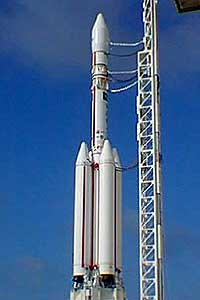
VLS is a four-stage Brazilian rocket comprised of a core and four strap-on motors. The first, or booster stage, has four solid fuel motors strapped to the center second-stage core motor. Much of the rocket motor technology used on the VLS is derived from the Sonda-3 and Sonda-4 sounding rockets. The VLS is designed to deploy 100- to 380-kilogram satellites into 200- to 1200-kilometer equatorial circular orbits, or to deploy 75- to 275-kilogram payloads into 200- to 1000-kilometer polar circular orbits. Configured as a missile, the VLS could fly 3,600 kilometers with a 500-kilogram nuclear payload. Launches are from Alcantara.
The first launch of the VLS ended in failure on 20 November 1997, when it was destroyed 65 seconds into the flight. According to reports, the rocket was off course and tilting to one side because one of the four solid rocket propellant strap-on motors failed to ignite. In December 1999, a second VLS had to be destroyed just three minutes into the flight when the rocket again veered off course. A third qualification flight had been scheduled for 25 August 2003; however, the rocket exploded on the pad three days before this during final preflight processing.

