
Viking pyrolytic release (PR) experiment
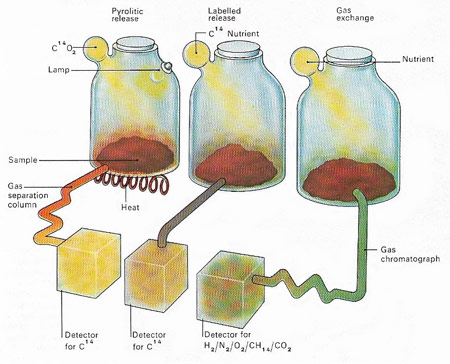
Figure 1. Each Viking lander had an automatic biology laboratory to which soil samples were delivered by a mechanical scoop in three experiments:Pyrolytic Release was designed to detect any microorganisms that live by photosynthesis, taking carbon dioxide, and using it to make organic matter in artificial sunlight (lamp). Labelled Release looked for signs of metabolism, evidence that organisms in the soil were maintaining and reproducing themselves. Gas Exchange looked for any exchange of gases between microbes in the soil and atmosphere of the chamber.
The Viking pyrolytic release (PR) experiment, headed by Norman Horowitz, was also known as the 'carbon assimilation' experiment.1 Of the three Viking biology experiments (Figure 1), this was the only one to attempt to detect signs of life in the complete absence of water and organic nutrients.
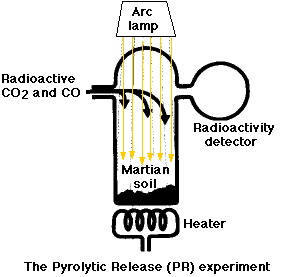 |
It was assumed that any organisms on Mars would have developed the ability to assimilate carbon dioxide and carbon monoxide from the atmosphere and convert these, in the absence of water, to organic matter. Therefore, the PR experiment exposed a small sample of Martian soil to quantities of these two gases which had been labeled with radioactive carbon-14 for detection purposes. After 120 hours of incubation under an artificial sun (a xenon arc lamp), the soil chamber was heated to about 625°C to break down (pyrolyze) any organic matter and release the volatile organic products for subsequent testing by a radiation counter. Since any organisms present would be expected to carry out metabolic processes during which they would take in carbon-14 from the gas in the chamber, detection of carbon-14 would be a positive result. It would not, however, be conclusively biological, since a first peak of radioactivity might equally be due to purely chemical processes. In order to rule out this possibility, other samples, serving as controls, were sterilized by heating before the carbon source was admitted.
Reference
1. Horowitz, N. H., Hubbard, J. S., and Hobby, G. L. "The Carbon-Assimilation Experiment: The Viking Mars Lander," Icarus, 16, 147 (1972).
