Vostok
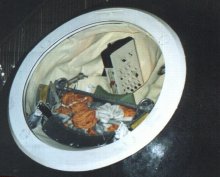
Vostok capsule.

Launch of Vostok 1.
Vostok was the first series of manned Russian spacecraft. Six Vostok ('East') missions, from 1961 through 1963, carried cosmonauts on successively longer flights, and each set a new first in spaceflight history. Vostok 1 was the first manned spacecraft to complete a full orbit, Vostok 2 the first to spend a full day in space. Vostoks 3 and 4 comprised the first two-spacecraft mission. Vostok 5 was the first long-duration mission, and Vostok 6 the first to carry a woman.
Yuri Gagarin's historic flight was preceded by a number of unmanned missions to test the space-worthiness of the Vostok capsule and the reentry and recovery method to be used. These test flights were known in the west as Sputnik 4, 5, 6, 9, and 10 but in the Soviet Union as Korabl Sputnik 1–5.
Vostok spacecraft
The Vostok spacecraft was a spherical cabin, 2.3 meters in diameter, attached to a biconical instrument module. The cabin was occupied by a single cosmonaut sitting in an ejection seat which could be used if problems arose during launch and was activated after reentry to carry the pilot free of the landing sphere. Also inside the cabin were three viewing portholes, film and television cameras, space-to-ground radio, a control panel, life-support equipment, food and water. Two radio antennas protruded from the top of the capsule, and the entire sphere was coated with ablative material so that there was no need to stabilize it to any particular attitude during reentry. The instrument module, which was attached to the cabin by steel bands, contained a single, liquid-propellant retrorocket and smaller attitude control thrusters. Round bottles of nitrogen and oxygen were clustered around the instrument module close to where it joined the cabin.
Vostok rocket
The Vostok rocket was essentially the same rocket (a modified R-7 ballistic missile; see "R" series of Russian missiles) that had launched Sputnik 1, 2, and 3, but with an upper stage supported by a latticework arranged and powered by a single RD-7 engine. The combination could launch an LEO payload of about 4,700 kilograms.
Vostok missions
Vostok 1
Yuri Gagarin made history with his, 108-minute, 181 × 327-kilometer single-orbit flight around the world. Once in orbit, he reported that all was well and began describing the view through the windows. Gagarin had brought a small doll with him to serve as a gravity indicator: when the doll floated in midair he knew he was in zero-g. (On 12 April 1991, Musa Manarov, the man who had by then logged the most time in space (541 days) carried the same doll back into orbit to mark aboard Mir the 30th anniversary of Gagarin's flight.) Gagarin had no control over his spacecraft: a "logical lock" blocked any actions he might make in panic because, at the time, little was known of how humans would react to conditions in space. In case of emergency, Gagarin had access to a sealed envelope in which the logical lock code was written. To use the controls he would have had to prove that he was capable of doing the simple task of reading the combination and punching three of nine buttons. However, in the event, this proved unnecessary and radio signals from the ground guided the spacecraft to a successful reentry. At a height of 8,000 meters, Gagarin ejected from his capsule and parachuted to the ground, southeast of Moscow near the Volga river, some 1,600 kilometers from where he took off. Official details of the flight were not released until 30 May when an application was issued to the International Aeronautical Federation (FAI) to make the flight a world record. Gagarin's midair departure from Vostok was kept a secret much longer because the FAI required the pilot to return in his craft in order for the record to be valid. It would be another month before Alan Shepard made his suborbital flight, and 10 months before John Glenn became the first American in orbit.
Vostok 2
The first manned spaceflight to last a whole day. The 36-year-old pilot, Titov, ate some food pastes on his third orbit and later took manual control and changed the spacecraft's attitude. About 10 hours into the mission, he tried to catch some sleep but became nauseous – the first of many space travelers to experience space motion sickness. However, Titov did eventually fall asleep for over seven hours before waking for a perfect reentry and landing, 25 hours 18 minutes after launch.
Vostok 3 and 4
The first manned double launch. Vostok 3 and 4 took off from the same launch pad a day apart and were placed in such accurate orbits that the spacecraft passed within 6.5 kilometers of each other. No closer rendezvous than this was possible, however, because the Vostoks were not equipped for maneuvering. The joint flight continued, with the two cosmonauts, Nikoleyev and Popovitch, talking to each other and with ground control by radio. Finally, the spacecraft reentered almost simultaneously and landed just a few minutes apart.
Vostok 5 and 6
Another double launch, this time involving the first woman in space – 26-year-old Valentina Tereshkova. She returned to Earth after almost three days in orbit, followed by Valery Bykovsky a few hours later at the conclusion of a five-day flight that has remained ever since the longest mission by a single-seater spacecraft.
| mission | launch | recovery | orbits | pilot |
| Vostok 1 | Apr 12, 1961 | Apr 12, 1961 | 1 | Yuri Gagarin |
| Vostok 2 | Aug 6, 1961 | Aug 7, 1961 | 17 | Gherman Titov |
| Vostok 3 | Aug 11, 1962 | Aug 15, 1962 | 64 | Adrian Nikolayev |
| Vostok 4 | Aug 12, 1962 | Aug 15, 1962 | 48 | Pavel Popovich |
| Vostok 5 | Jun 14, 1963 | Jun 19, 1963 | 81 | Valery Bykovsky |
| Vostok 6 | Jun 16, 1963 | Jun 19, 1963 | 48 | Valentina Tereshkova |