
ALEXIS
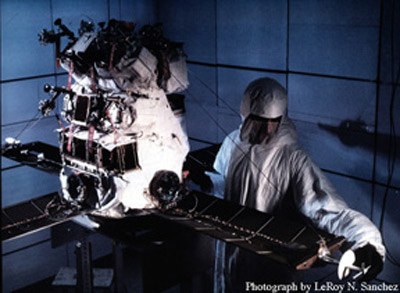
ALEXIS was a small American Department of Defense spacecraft that has provided high-resolution maps of astronomical X-ray sources. The mission was also intended to demonstrate the feasibility of quickly building low-cost sensors for arms treaty verification.
ALEXIS was equipped with six coffee-can-sized telescopes that worked in pairs to make observations in the soft (longer wavelength) X-ray and extreme ultraviolet (EUV) part of the spectrum. Among its science objectives were to survey and map the diffuse soft X-ray component of the sky, to look at known bright EUV sources, to search for transient (fast changing) behavior, and to study stellar flares.
One of the first of the modern generation of miniature spacecraft, ALEXIS was designed and built over a three-year period by Los Alamos National Laboratory, Sandia National Laboratory, Space Sciences Laboratory at the University of California, Berkeley, and AeroAstro, Inc.
| launch date | Apr 25, 1993 |
| launch vehicle | Pegasus |
| launch site | Edwards Air Force Base |
| orbit | 741 × 746 km × 69.8° |
| mass | 115 kg |

