
Able
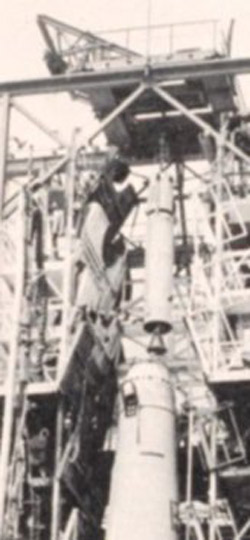
Able second stage of a Thor-Able rocket being set in place prior to launching TIROS I. Credit: US Navy.
1. Able was a modified form of the Aerojet AJ-10 second stage of the Vanguard rocket used as the second stage of the Thor-Able, Thor-Able Star, and Atlas-Able launch vehicles.
2. Able was also an early, ill-fated American lunar program approved by President Eisenhower on 27 March 1958, and intended to place a satellite in orbit around the Moon. Project Able became the first lunar shot in history, preceding even Luna 1, when a Thor-Able took off at 12:18 GMT on17 August 1958, before a small group of journalists. Unfortunately, only 77 seconds into the flight, the Thor's turbopump seized and the missile blew up. Telemetry from the probe was received for a further 123 seconds until the 39-kilogram spacecraft ended its brief journey by falling into the Atlantic. Although not given an official name the probe is referred to as Pioneer 0 or Able 1. Before the launch of the second probe the whole program was transferred to NASA, which renamed it Pioneer.
3. Able may also refer to a rhesus monkey that was housed in a biocapsule and sent on a suborbital flight by a specially-configured Jupiter missile on 28 May 1959. Able and its companion Baker, a female squirrel monkey placed in a second biocapsule, became the first live animals to be recovered after traveling outside Earth's atmosphere. Able died on 1 June 1959, from the effects of anesthesia given to allow the removal of electrodes. An autopsy revealed that it had suffered no adverse effects from its flight.1 See also animals in space.
Reference
1. Powell, J. W. "The Flight of Able and Baker." Journal of the British Interplanetary Society 38 (1985): 94–96.

