
Aeros
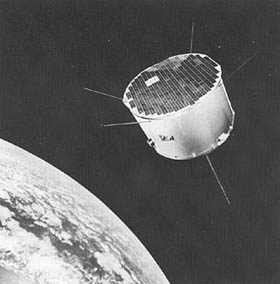
Artist's concept of Aeros in orbit.
In June 1969, NASA and the German Ministry for Scientific Research (BMwF) agreed a cooperative project that would orbit a German scientific satellite designed to study particle behavior in Earth's upper atmosphere. In early 1969 BMwF named the proposed aeronomy satellite after Aeros, ancient Greek god of the air. Aeros, the second US-German cooperative research satellite, following Azur, was designated GRS-A-2 by NASA before launch, assuming its proper name when successfully launched. ("Aeros" also had been used earlier as a name for the Synchronous Meteorological Satellite project.)
| spacecraft | launch date | mass | orbit |
| Aeros 1 | Dec 16, 1972 | 127 kg | 223 × 867 km × 96.9° |
| Aeros 2 | Jul 16, 1974 | 127 kg | 224 × 869 km × 97.5° |

