
Ångström, Anders Jonas (1814–1874)
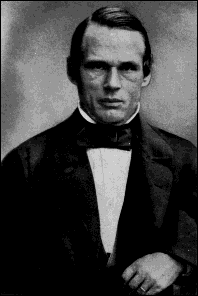
Anders Ångström was a Swedish physicist and pioneer of spectroscopy at the university of Uppsala who deduced in 1855 that a hot gas emits light at the same wavelengths at which it absorbs light when cooler – a fact demonstrated experimentally by Gustav Kirchhoff four years later. In 1861 Ångström began a study of the solar spectrum, proving the existence of hydrogen in the Sun and mapping about 1,000 lines seen earlier by Josef Fraunhofer (see Fraunhofer lines). He recorded his measurements in units of 10-10 meter – a unit subsequently named in his honor (see angstrom). Ångström was also the first to examine the spectra of aurorae.
Ångström entered the university of Upsala (1833), then became a privat-docent (1839), keeper of the observatory (1843), and professor of physics (1858). From 1867 till his death, he acted as secretary to the Royal Society of Sciences at Upsala. Among his chief published works were Recherches sur le Spectre solaire (Berlin, 1869), Sur les Spectres des Gas simples (1871), and Mémoire sur la Temperature de la terre (1871).

