Apollo 10
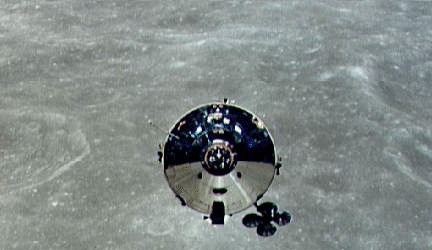
Apollo 10 Command and Service Module with Moon in the background photographed from the Lunar Module.
Apollo: 7|8|9|10|11|12|13|14|15|16|17
Apollo 10 was the fourth manned flight of the Apollo Project and the final rehearsal for the first manned lunar landing.
Apollo 10's main purpose was to test rendezvous and docking operations between the Command and Service Module (CSM) and the Lunar Module (LM) in lunar orbit. Having entered orbit around the Moon, astronauts Stafford and Cernan transferred to the LM, undocked it, and flew within 15,200 meters of the Moon's surface. After the LM descent stage had been jettisoned prior to re-docking, the orientation of the ascent stage began to change unexpectedly due, it turned out, to an incorrectly placed switch. The astronauts took manual control of the LM and were able successfully to rendezvous and re-dock with the CSM. The Apollo 10 crew achieved the highest speed ever attained by human beings – 39,896 kilometers per hours. This was also the highest speed of entry into Earth's atmosphere by any spacecraft until it was surpassed by the Stardust probe.
| commander | Thomas Stafford |
| lunar module pilot | Eugene Cernan |
| command module pilot | John Young |
| call signs | CM: Charlie Brown, LM: Snoopy |
| launch | May 18, 1969; 16:49:00 UT (12:49:00 pm EDT) Kennedy Space Center Launch Complex 39B |
| mission duration | 192 h 3 min 23 s |
| splashdown | May 26, 1969; 16:52:23 UT (12:52:23 pm EDT) |
| retrieval site | Pacific Ocean 15° 2' S, 164° 39' W |
Highlights