Project Apollo
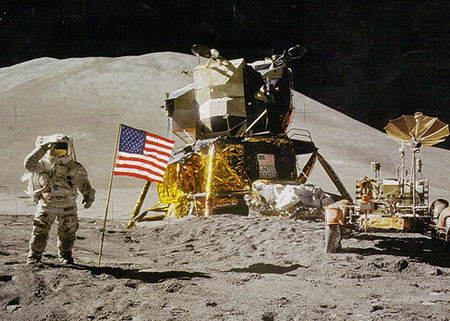
James Irwin on the Moon during the Apollo 15 mission.
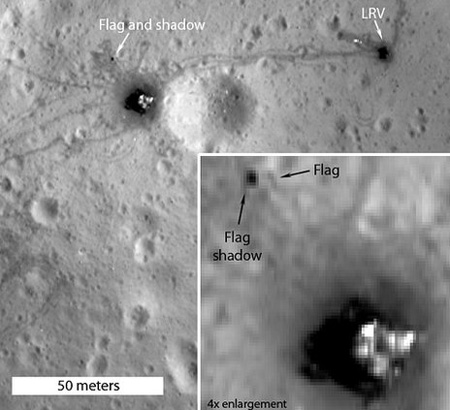
An image of the Apollo 16 landing site showing the Lunar Module descent stage and other equipment left on the Moon, including the flag.
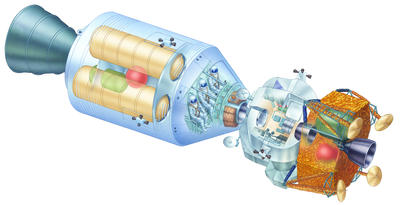
Apollo spacecraft.
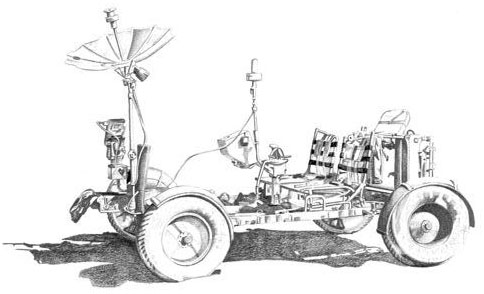
Apollo 17 lunar rover. Artwork by Jeff Darling.

The Apollo landing sites.
Project Apollo, also known as the Apollo program, was NASA's manned space program that built on the achievements of Mercury and Gemini and eventually landed 12 astronauts on the Moon. Undertaken at a time of intense military rivalry with the Soviet Union, it demanded rapid progress in all aspects of spaceflight. Apollo hardware was also used for other missions, including Skylab and the Apollo-Soyuz Test Project. The success of the Apollo Project rested on the development of the Saturn series of launch vehicles, and, in particular the Saturn V moon rocket. In September 2005 NASA announced plans to return to the Moon by 2020 using the Apollo-like Crew Exploration Vehicle. In August 2006, NASA renamed this spacecraft Orion.
Apollo history
On 29 July 1960, NASA unveiled a plan to develop a three-man spacecraft called Apollo capable of operating in low Earth or circumlunar orbit. President Eisenhower initially opposed this development beyond the Mercury Project, but Apollo was given the green light by his successor on 21 May 1961, when President Kennedy declared America's goal of placing humans on the Moon by the end of the decade. As a NASA historian observed,1 the decision "owed nothing to any scientific interest in the Moon. The primary dividend was to be national prestige." Not surprisingly, given that beating the Soviets was the main objective, public and government interest in Apollo rapidly waned after the Space Race was won.
NASA leaders had to choose between three ways of getting astronauts to and from the lunar surface: direct ascent, Earth-orbit rendezvous, and lunar-orbit rendezvous. Direct ascent meant sending a single spacecraft on a straight shot from Earth's surface to the Moon's surface with enough propellant for the return journey, and could only be done with the development of a huge new rocket known as the Nova. Earth orbit rendezvous involved first placing the moonship in low Earth orbit, then fueling its booster – a scheme that called for the launch of two Saturn Vs. Only the lunar orbit rendezvous approach would enable the mission to be accomplished with the launch of a single Saturn V and, mainly for this reason, was the one selected by NASA in June 1962.
North American Aviation was chosen to develop the main part of the craft, the so-called Command and Service Module, which could operate together with or independently of a special Lunar Module. To speed development, Apollo vehicles were built in two configurations: Block 1 and Block 2. The former was intended only for test missions in Earth orbit; the latter was more sophisticated and reserved for the Moon shots themselves. However, following a fire which cost the lives of three astronauts (see below), the Apollo design was overhauled and no Block 1s were launched with a crew aboard. The rest of the Apollo program proved to be a triumph of technology and human endeavor.2, 3, 4
Apollo spacecraft
Carried into space atop a Saturn launch vehicle were the Command Module (CM), the Service Module (SM), and the Lunar Module (LM). Unmanned test flights and one manned test flight, Apollo 7, were launched by Saturn IBs; all other manned Apollos were launched by Saturn Vs.
Command Module (CM)
A conical three-man capsule that served as the control center and main living area; the CM was the only part of Apollo built to withstand the heat of reentry. The forward section contained a pair of thrusters for attitude control during reentry, parachutes for landing, and a tunnel for entering the LM. At the end of the tunnel was an airtight hatch and a removable docking probe used for linking the CM and LM.
Crewmen spent much of the time on their couches, but could leave them and move around. With the seat portion of the center couch folded, two astronauts could stand at the same time. The astronauts took turns sleeping in two sleeping bags mounted beneath the left and right couches. Food, water, clothing, waste management, and other equipment were packed into bays which lined the walls of the craft. The pressurization (about one third of sea-level pressure), temperature (about 24°C), and controlled atmosphere afforded a shirtsleeve environment. Spacesuits were only worn during critical phases of a mission such as launch, entry, docking, and crew transfer. The left-hand couch was occupied by the commander who, in addition to the duties of command, normally worked the spacecraft's flight controls. The center couch was for the CM pilot, whose main task was guidance and navigation, although he also sometimes flew the craft. On a lunar mission, the CM pilot remained in the CM while his two companions descended to the Moon's surface. In the right-hand couch was the LM pilot, mainly responsible for managing the spacecraft's subsystems.
The CM had five windows: two forward-facing for use during docking with the LM and three others for general observation. A hatch opposite the center couch was used to enter and leave the CM on the ground. The aft section contained 10 reentry thrusters, their fuel tanks, and the heat-shield.
| height | 3.2 m |
| diameter (at base) | 3.9 m |
| mass at launch, including crew | 5,900 kg |
| mass at splashdown | 5,300 kg |
Service Module (SM)
An aluminum alloy cylinder at the end of which was the main engine used to place Apollo into lunar orbit and begin the return to Earth. The SM carried the hypergolic (self-igniting) propellants for the main engine, the systems (including fuel cells) used to generate electrical power, and some of the life-support equipment. At four locations on the SM's exterior were clusters of attitude control jets. On the Apollo 15, 16, and 17 missions, the SM also contained a scientific instrument module (SIM) with cameras and others sensors for studying the Moon from orbit.
| diameter | 3.9 m |
| length | 7.5 m |
| engine thrust | 91,000 N |
| propellants | hydrazine, UDMH, nitrogen tetroxide |
Command and Service Module (CSM)
The combined CM and SM. The CSM orbited the Moon, while the LM conveyed two astronauts to and from the lunar surface, and subsequently provided the means of returning to Earth.
Lunar Module (LM)
The part of the Apollo spacecraft in which two astronauts could travel to and from the Moon's surface; it was the first manned spacecraft designed for use exclusively outside Earth's atmosphere. Built by Grumman Aircraft, the LM was a two-stage vehicle consisting of an ascent stage and a descent stage. During descent to the lunar surface and while the astronauts were on the Moon, these stages acted as a single unit. The descent stage contained the components used to de-orbit and land the LM, including the main engine, propellants, and landing gear. Its engine was the first in the American space program that could be throttled, providing a thrust range of 4,890–43,900 newtons (N), and could swing through 6° from vertical in two planes to give the vehicle maneuverability in landing. The ascent stage, equipped with its own engine of 15,600-N thrust, separated at the start of the climb back to lunar orbit and used the descent stage as a launch platform. Given that every kg of the LM had to be paid for with 70 kilograms of launch vehicle and fuel from Earth, the LM was made as light as possible. Its main cladding was a paper-thin skin of aluminum alloy fixed to aluminum alloy stringers. The ascent stage also had several skins of Mylar to serve as heat and micrometeoroid shields. The ladder enabling the astronauts to climb to the lunar surface was so flimsy that it could only support a man's weight in the one-sixth gravity of the Moon. Weight limitations also meant the absence of bunks, so that the astronauts could only rest on the floor, and of an airlock, so that the module had to be depressurized and repressurized before and after every excursion. For this reason, and to avoid being locked out of their vehicle so far from home, the astronauts left the hatch slightly ajar during their moonwalks.5
| height | 6.7 m |
| shortest distance across descent stage | 4.3 m |
| shortest distance across landing gear, diagonally | 9.4 m |
| mass, fully loaded, earlier missions | 14,500 kg |
| mass, fully loaded, later missions | 15,900 kg |
Launch Escape System (LES)
A 4,000-kilogram tower-like structure, carrying four solid-propellant motors, mounted on top of the CM at takeoff and later jettisoned. In the event of a booster failure or some other imminent danger, the LES could be fired to lift the CM clear of the Saturn V. The LES engines, with a thrust of 654,000 N, were more powerful than the entire Redstone launcher that put the first American into suborbital space, and could provide an acceleration of about 6.5g. As the maximum acceleration during ascent for Apollo-Saturn V was about 4g, the CM/LES combination could still be separated, even if the Saturn V engines were running at full thrust.
Lunar Roving Vehicle (LRV)
A two-person open automobile, powered by electric batteries and used on the Moon's surface during the last three Apollo missions. The collapsible LRV was fixed to the side of the LM, and released and unfolded by pulling a cord. It enabled several trips by the astronauts of Apollo 15, 16, and 17, covering total distances of 28, 27, and 35 kilometers, respectively. The TV camera on the second LRV was used to televise live the launch of the Apollo 16 LM ascent stage. Left on the Moon, the LRVs will be available if needed by future lunar missions. For more information, see separate entry on Lunar Roving Vehicle.
| mass, maximum, with payload | 700 kg |
| mass, vehicle only | 210 kg |
| length | 3.48 m |
| width | 1.83 m |
| wheelbase | 2.29 m |
| power supply | two 36-V batteries (with one backup) |
| maximum speed | 14 km/h (design), 17.1 km/h (actual) |
| cumulative endurance | 78 hours |
| design range | 92 km |
ALSEP (Apollo Lunar Science Experiment Package)
A set of experiments deployed by astronauts on the Moon. An ALSEP was left by every mission except the first. Each was powered by a small nuclear generator and included a seismometer to measure moonquakes, a solar wind detector, and instruments to measure any trace atmosphere and heat flow from the Moon's interior. All the experiments were turned off in 1978.6
Apollo missions
The manned Apollo flights were preceded by a number of unmanned test flights of the Saturn IB and Saturn V launch vehicles. Data from the Lunar Orbiter and Surveyor missions were used in selecting sites for the Apollo lunar landings.
Disaster struck the program on 27 January 1967. "Gus" Grissom, Roger Chaffee, and Ed White, assigned to the first manned Apollo test flight, had entered the CM for a countdown rehearsal. Just after 6:30 pm, with the capsule sealed and the countdown at T-10 minutes, Grissom cried out "Fire in the spacecraft!" In moments the interior was ablaze in the capsule's pure oxygen atmosphere and the exterior became so hot that technicians were unable to make a speedy rescue. A post-mortem revealed that the astronauts had died within seconds, principally from smoke inhalation. Ironically, while everything else but metal inside the capsule was badly burned, a portion of the flight plan survived with only a few pages singed. The post-accident inquiry laid most of the blame on a poorly designed hatch which was impossible to open in under 1.5 minutes and on the use of pure oxygen, which had allowed a small spark (possibly from poorly insulated wires under Grissom's seat) to become a conflagration. Flash fires had previously broken out in two boilerplate cabin mock-ups in September and November 1963. Also, Soviet cosmonaut Valentin Bondarenko was killed in a pure oxygen flash fire in a training simulator in March 1961, although this was only revealed in the late 1980s. A new hatch had been under development at the time of the Apollo tragedy, but the inquiry revealed a catalogue of bad design and shoddy workmanship throughout the Apollo spacecraft. Although the program was delayed by 18 months following the fatal ground test-named Apollo 1 in retrospect to honor the three astronauts who died – the result was a safer vehicle for those destined to fly to the Moon.
Postscript (provided by Jim Warren, Birmingham, UK): The US did not at this time have rockets as powerful as those of the Soviet Union; thus, the weight of the American modules had to be minimized. By filling them with pure oxygen rather than air, the pressure inside was reduced in theory to about a fifth of atmospheric pressure, although in practice to about a third. This meant that the module walls could be thinner and lighter. The downside was that a fire would, and did, kill the astronauts almost instantaneously. The decision to take this risk with the astronauts' lives was disgraceful. Sadly, similar decisions were taken in the Space Shuttle program, when extra crew were shoe-horned in at the expense of escape systems.
| Mission | Date | Notes |
| AS-201 | Feb 26, 1966 | First unmanned test flight of Saturn IB-Apollo |
| AS-203 | Jul 5, 1966 | Second unmanned test flight of Saturn IB-Apollo |
| AS-202 | Aug 25, 1966 | Third unmanned test flight of Saturn IB-Apollo |
| Apollo 1 (AS-204) | Jan 27, 1967 | Fatal fire during countdown test |
| Apollo 4 | Nov 9, 1967 | First unmanned test flight of Saturn V |
| Apollo 5 | Jan 22-24, 1968 | Unmanned LM test in Earth orbit (Saturn IB) |
| Apollo 6 | Apr 4, 1968 | Second unmanned test flight of Saturn V |
Apollo 7 and 9 were Earth-orbiting missions to test the CM and LM. Apollo 8 and 10 tested various components while orbiting the Moon. Apollo 13 did not land on the Moon due to a major malfunction en route. The six missions that did land (Apollo 11, 12, 14, 15, 16, and 17) brought back a wealth of scientific data and nearly 400 kg of lunar samples. Experiments provided information on soil mechanics, meteoroid impacts, seismic activity, heat flow through the soil, magnetic fields, the solar wind, and the precise distance to the Moon.
| Manned Apollo flights | |||||
|---|---|---|---|---|---|
| Mission | Launch date | Lunar landing | Recovery | Duration | Crew |
| Apollo 7 | Oct 11, 1968 | - | Oct 22, 1968 | 10 days 20 h | Schirra Eisele Cunningham |
| Apollo 8 | Dec 21, 1968 | - | Dec 27, 1968 | 6 days 3 h | Borman Lovell Anders |
| Apollo 9 | Mar 3, 1969 | - | Mar 13, 1969 | 10 days 1h | McDivitt Scott Schweickart |
| Apollo 10 | May 18, 1969 | - | May 26, 1969 | 8 days 3 h | Stafford Young Cernan |
| Apollo 11 | Jul 16, 1969 | Jul 20, 1969 | Jul 24, 1969 | 8 days 3 h | Armstrong Aldrin Collins |
| Apollo 12 | Nov 14, 1969 | Nov 19, 1969 | Nov 24, 1969 | 10 days 4 h | Conrad Gordon Bean |
| Apollo 13 | Apr 11, 1970 | - | Apr 17, 1970 | 5 days 23 h | Lovell Swigert Haise |
| Apollo 14 | Jan 31, 1971 | Feb 5, 1971 | Feb 9, 1971 | 9 days 0 h | Shepard Roosa Mitchell |
| Apollo 15 | Jul 26, 1971 | Jul 30, 1971 | Aug 7, 1971 | 12 days 17 h | Scott Worden Irwin |
| Apollo 16 | Apr 16, 1972 | Apr 29, 1972 | Apr 27, 1972 | 11 days 1 h | Young Duke Mattingley |
| Apollo 17 | Dec 7, 1972 | Dec 11, 1972 | Dec 19, 1972 | 12 days 14 h | Cernan Evans Schmidt |
For details of specific missions, see:
US flags on the Moon
Photos taken by Lunar Reconnaissance Orbiter have shown conclusively that all the flags – except one – set up at the Apollo landing sites are still standing. The only one to have fallen is the Apollo 11 flag, blown down by the rocket exhaust of the Lunar Module ascent stage as it departed the Moon. The LRO images clearly show the images cast by the other flags, proving that despite harsh temperature changes, they've remained erect – although the colors of the flags may well have faded because of the intense UV bombardment. For more, go here (BBC).
References
1. Hall, R. Cargill. "The Eisenhower Administration and the Cold War:
Framing American Astronautics to Serve National Security." Prologue
: Quarterly of the National Archives 27 (1995): 59-72.
2. Allday, Jonathan. Apollo in Perspective: Spaceflight Then and
Now. Bristol, England: Institute of Physics Publications, 2000.
3. Benson, Charles D., and William B. Faherty. Moon Launch! (The Apollo History Series). Gainesville, Fla.: University Press of
Florida, 2001.
4. Compton, William. Where No Man Has Gone Before: A History of the
Lunar Exploration Missions. Washington, D.C., 1989: National Aeronautics
and Space Administration Special Publications 4214.
5. Kelly, Thomas J. Moon Lander: How We Developed the Apollo Lunar
Module. Washington, D.D.: Smithsonian Institution Press, 2001.
6. Beattie, Donald A. Taking Science to the Moon: Lunar Experiments
and the Apollo Program. Baltimore: Johns Hopkins University Press,
2001.