
Arcturus (Alpha Bootis)
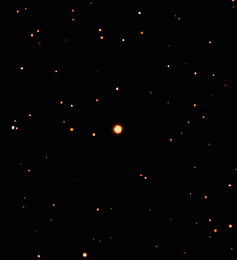
Arcturus. Photo: ESO.
Arcturus (Alpha Bootis) is the brightest star in the constellation Boötes and in the entire northern hemisphere, and the fourth brightest in the sky; its Greek name means the "Bear Watcher," in reference to the star's apparent pursuit of Ursa Major around the pole. An orange subgiant K star, Arcturus has a velocity somewhat higher than that of other bright stars, and comes from an older population of the Galaxy. Consistent with this, it is rather metal-poor with only about one-fifth as much iron relative to hydrogen as is found in the Sun. It is probably at the stage of fusing helium to carbon in its core.
Arcturus became famous when its light was used to open the 1933 World's Fair in Chicago – this light having started its journey at about the time of the previous Chicago fair in 1893. Arcturus was one of the first stars to have its proper motion measured. It is the scene for David Lindsay's classic fantasy A Voyage to Arcturus.
| visual magnitude | -0.05 |
| absolute magnitude | -0.30 |
| spectral type | K2IIIp |
| surface magnitude | 4,290 K |
| luminosity | 180 Lsun |
| radius | 23 Rsun |
| mass | 1.5 Msun |
| distance | 37 light-years |
| position | RA 14h 15m 39.7s, Dec +19° 10' 57" |

