andesite
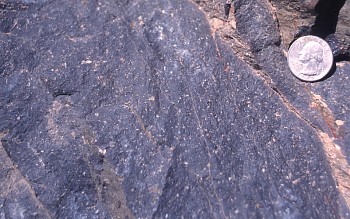
Close view of andesite lava flow on Brokeoff Volcano, California. Credit: U.S. Geological Survey
Andesite is a dark-colored, fine-grained extrusive igneous rock with about 52 to 63% by weight of silica (SiO2). Andesites contain crystals composed primarily of plagioclase feldspar and one or more of the minerals pyroxene (clinopyroxene and orthopyroxene) and lesser amounts of hornblende. At the lower end of the silica range, andesite lava may also contain olivine. Although largely many up very small crystals, andesite occasionally contains larger crystals called phenocrysts.
Andesite magma commonly erupts from stratovolcanoes as thick lava flows, some reaching several kilometers in length. Andesite magma can also generate strong explosive eruptions to form pyroclastic flows and surges and enormous eruption columns. Andesites erupt at temperatures between 900° and 1100°C.
The word "andesite" is derived from the Andes Mountains, located along the western edge of South America, where andesite rock is common. Andesites occur in composite volcanic cones associated with convergent plate margins.