
volcanic ash
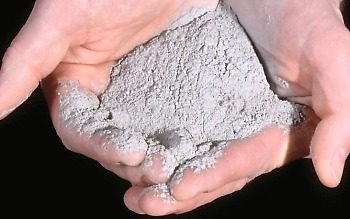
Volcanic ash collected in Randle, Washington, located about 40 kilometers NNE of Mount St. Helens. The north edge of the eruption cloud of 18 May 1980, passed over Randle and deposited between 1 and 2 centimeters of ash on the community. At the same distance along the axis of the eruption cloud, however, about 7 centimeters of ash and larger-sized tepra fell to the ground. Credit: D. E. Wieprecht / U.S. Geological Survey.
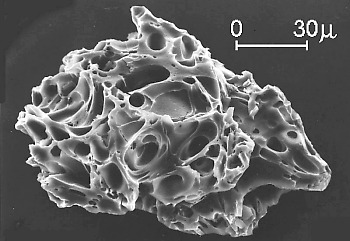
Close view of a single ash particle from the eruption of Mount St. Helens; image is from a scanning electron microscope (SEM). The tiny voids or "holes" are called vesicles and were created by expanding gas bubbles during the eruption of magma. Credit: A. M. Sarna-Wojcicki / U.S. Geological Survey.
Volcanic ash is fine particles of pulverized rock blown from an explosion vent. Volcanic ash consists of rock, mineral, and volcanic glass fragments smaller than 2 millimeters (0.1 inch) in diameter, which is slightly larger than the size of a pinhead. Volcanic ash is not the same as the soft fluffy ash that results from burning wood, leaves, or paper. It is hard, does not dissolve in water, and can be extremely fine – ash particles less than 0.025 millimeter (1/1,000th of an inch) in diameter are common.
Ash is extremely abrasive, similar to finely crushed window glass, mildly corrosive, and electrically conductive, especially when wet.
Volcanic ash is created during explosive eruptions by the shattering of solid rocks and violent separation of magma (molten rock) into tiny pieces. Explosive eruptions are generated when groundwater is heated by magma and abruptly converted to steam and also when magma reaches the surface so that volcanic gases dissolved in the molten rock expand and escape (explode) into the air extremely rapidly. After being blasted into the air by expanding steam and other volcanic gases, the hot ash and gas rise quickly to form a towering eruption column directly above the volcano. The cone of a compound volcano consists of accumulated layers of ash and lava.

