
Canis Major Dwarf
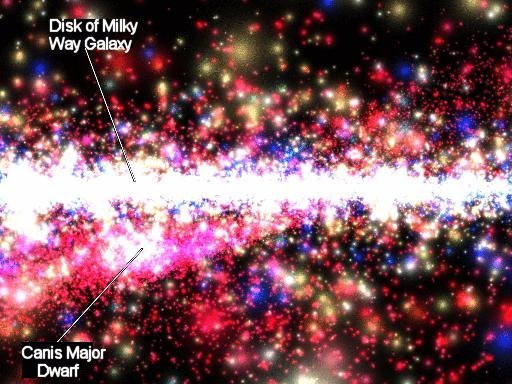
Canis Major Dwarf galaxy.
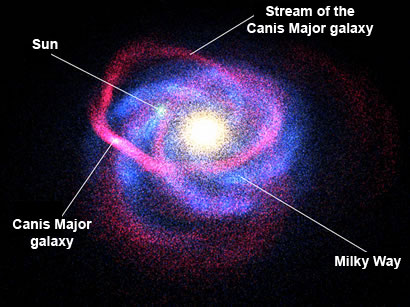
Canis Major Dwarf and Monoceros Ring.
The Canis Major Dwarf is an irregular dwarf galaxy that is a satellite of our own Milky Way Galaxy. It lies in the constellation Canis Major at a distance of only 25,000 light-years from the Sun and 42,000 light-years from the center of the Milky Way. Although it is the closest known satellite galaxy to the center of the Milky Way, pushing the Sagittarius Dwarf Elliptical (SagDEG) into second place, it is well hidden behind banks of dust in the plane of the Milky Way and was discovered thanks to the infrared glow of its M-type (red) giants by the Two-Micron All Sky Survey (2MASS) as recently as 2003.
The immense gravitational pull of the Milky Way has progressively stripped stars, star clusters, gas, and dust from the Canis Major Dwarf. Some of this material is now spread out in long tidal tails that are wrapped three times around the Milky Way in a structure called the Monoceros Ring. Several globular clusters in the Milky Way, which are loosely grouped around the nucleus of the Canis Major Dwarf, including M79, NGC 1851, NGC 2298, and NGC 2808, are also thought to have come from the satellite system. Indeed this little companion galaxy, astronomers suspect, may have increased the mass of our Galaxy by up to 1% over the course of many millions of years.
Both the Canis Major and Sagittarius Elliptical dwarfs are merging with, or being cannibalized by, the Milky Way – a process that will have run to completion within another billion years or so.
| apparent size | 720' |
| distance | 25,000 light-years |
| position | R.A. 07h 15m; Dec. -30° |

