
The Milky Way Galaxy
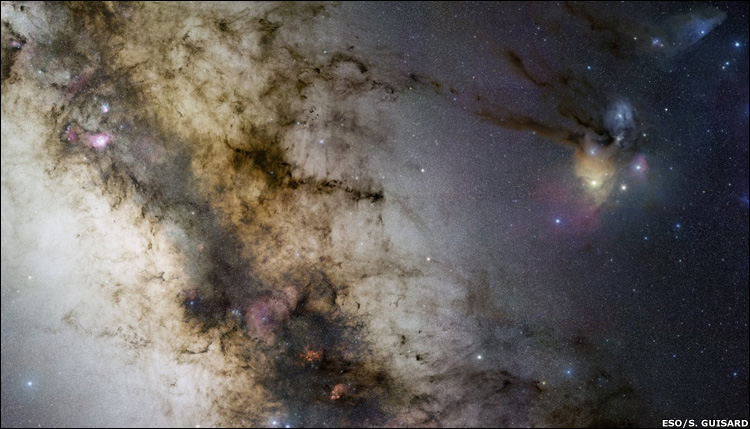
The center of the Milky Way Galaxy in a 340-million pixel image obtained from the European Southern Observatory's GigaGalaxy Zoom project. The image spans the constellations Sagittarius and Scorpius, with the Milky Way's dusty plane along a diagonal.

In 2008, it was announced that infrared images from NASA's Spitzer Space Telescope have shown that the Milky Way's elegant spiral structure is dominated by just two arms wrapping off the ends of a central bar of stars. Previously, our galaxy was thought to have four major arms. Image credit: NASA/JPL-Caltech.

An older map of the Milky Way Galaxy showing four major arms, with the Sun located in a region called the Orion Arm or Local Spur. Image credit: NASA.
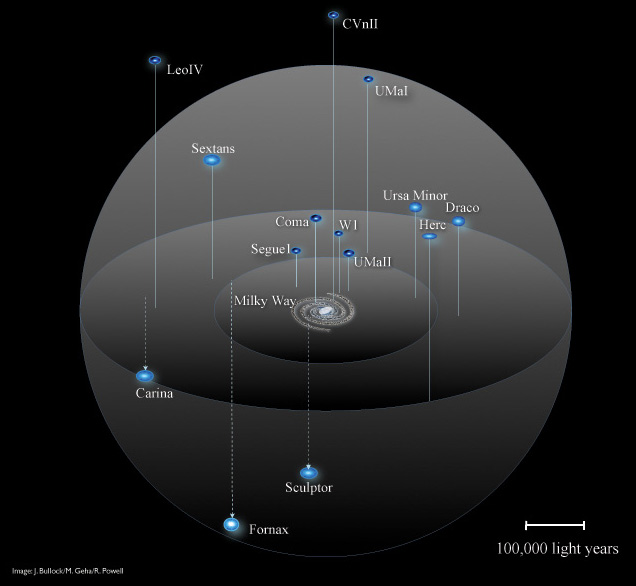
Satellite galaxies of the Milky Way.

One of two known twins of the Milky Way - Magellanic Clouds system. The larger galaxy, called GAMA202627, which is similar to our own has two large companions off to the bottom left of the image. Credit: Aaron Robotham, ICRAR/St Andrews using GAMA data.

Schematic is based on multiwavelength observations of a suspected jet from the massive black hole at the center of our galaxy. The wide view shows our galaxy edge-on, with two huge bubbles of plasma glowing in gamma-rays and X-rays. These are evidence for an explosive outburst from the black hole about 2 million years ago. Probing deep into the galaxy's core (inset), astronomers using the Hubble Space Telescope have captured a glowing cloud of hydrogen near the black hole. The interpretation is that the cloud is being hit by a narrow, columnated jet of material that was blasted out of the black hole merely 2,000 years ago. The black hole is still active, but on a smaller scale of energy output than previously known outbursts. When the jet slams into the hydrogen knot the outflow scatters into octopus-like tendrils that continue along a trajectory out of our galaxy. Credit: NASA, ESA, Gerald Cecil (UNC-Chapel Hill), Dani Player (STScI).
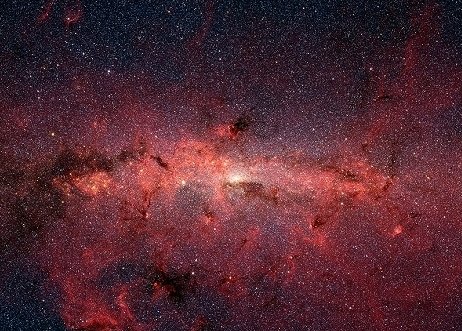
Infrared image of a region about 900 light-years wide in the direction of the Galactic Center. Image credit: NASA/JPL-Caltech/S. Stolovy (Spitzer Science Center/ Caltech).
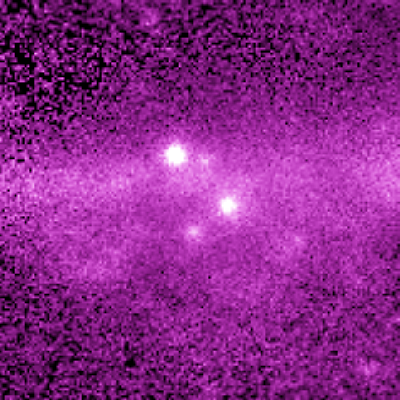
View of the galactic anticenter in gamma rays. Image: Compton Gamma Ray Observatory. Credit: NASA.
The Milky Way Galaxy, our home galaxy, is a large barred spiral galaxy containing some 200 to 400
billion stars (possibly many more if brown dwarfs are included). Its barred
structure, and the fact that its spiral arms are quite loosely wrapped, suggests that it is of type Sbc or SBbc in the
Hubble galaxy classification scheme. Its main components are a disk, a central bulge, and a halo.
Recent estimates put the total mass of the Milky Way Galaxy in the range
one to two trillion solar masses, including a large but uncertain amount
of dark matter in the dark
halo. The Milky Way is the second largest member of the Local
Group, after the Andromeda Galaxy.
| diameter | 100,000 light-years |
| thickness of disk | 2,300 to 2,600 light-years |
| thickness of bulge | 16,000 light-years |
| mass | 1–2 × 10¹² Msun |
| proportion of gas and dust | 5–10% of stellar mass |
| mean density | 0.1 Msun per cubic parsec |
| total luminosity | ~ 1044 erg/s |
| magnetic field< | 3–5 × 10⁻⁶ gauss |
| age (oldest star) | 13.2 billion years |
Disk and spiral arms
The disk of the Milky Way Galaxy is home to the spiral arms. These arms contain many ordinary, intermediate-age disk stars, such as the Sun, together with the more showy Population I objects, in the form of young, hot stars, stellar associations, open clusters, diffuse nebulae, and the bulk of the interstellar matter from which future stars will form.
Because we have no way (at present!) of viewing of our galaxy from the outside, the disk and the arms can only be mapped using observations made from our solar vantage point. Astronomers began this mapping in the 1950s based on radio wave observations of neutral hydrogen gas. These early data suggested the existence of four major star-forming arms, called the Norma, Scutum-Centaurus, Sagittarius, and Perseus Arm. The sun appeared to lie in a small, partial arm known as the Orion Arm, or Orion Spur, located between the Sagittarius and Perseus arms.
This traditional four-arm scheme has now been challenged by observations made in the infrared part of the spectrum. First, in the 1990s, infrared sky surveys led to the discovery of a large bar of stars stretching across the center of the Milky Way. In 2005, infrared measurements made with the Spitzer Space Telescope showed that the Milky Way's bar extends even farther out from the center of the galaxy than had previously been suspected. In 2008, new infrared imagery from Spitzer, encompassing 110 million stars and a swath of the Milky Way stretching 130 degrees across the sky and one degree above and below the galaxy's mid-plane, made a strong case for the existence of just two major spiral arms in the Milky Way – a common structure for barred galaxies. These major arms, the Scutum-Centaurus and Perseus arms, have the greatest densities of both young, bright stars, and older, so-called red-giant stars. The two minor arms, Sagittarius and Norma, are filled with gas and pockets of young stars. The two major arms appear to join up neatly with the near and far ends of the central bar.
The Sun is located 27,700 light-years from the center of the Milky Way Galaxy.
Galactic plane
The galactic plane is the plane in which the disk of the Galaxy lies. By definition, one direction perpendicular to this plane is called above or north, and the opposite direction, also perpendicular to the galactic plane, is called below or south. From Earth, due galactic north is marked by the north galactic pole, which lies in Coma Berenices, near the bright star Arcturus, and due galactic south is marked by the south galactic pole, which lies in Sculptor.
Bulge and halo
The galactic bulge and the much larger galactic halo contain Population II objects – mostly old stars and roughly 200 globular clusters, of which about 150 are known. These globulars are strongly concentrated toward the galactic nucleus.
Center and nucleus
TThe galactic center is the point about which the disk of the Galaxy rotates and it lies within the galactic nucleus. The nucleus of the Milky Way contains a complex of gas, dust, stars, supernova remnants, magnetic filaments, and, almost certainly, a supermassive black hole at the very center. It lies in the direction of Sagittarius, around RA 17h 46m and Dec -28° 56'. Lying dead center in the Galaxy is the Sagittarius A Complex, which is believed to be associated with the black hole, material in orbit around this object, and a nearby supernova remnant. Surrounding the galactic center are narrow threads known as nonthermal filaments (NTFs), the most prominent of which are called the Arc, the Pelican, and the Snake. These seem to consist of magnetic flux tubes filled with relativistic electrons, beaming synchrotron radiation, that have been swept up from adjacent molecular clouds and hurled along the field lines at incredible speeds. Another unusual structure in the nucleus is catalogued as 359.1-00.5 and appears to be a superbubble with a cluster of as many as 200 newborn stars at its heart.
Galactic anticenter
The galactic anticenter is the point in the galactic plane that lies directly opposite the galactic center. It lies in the constellation Auriga at approximately R.A. 05h 46m, Dec. +28° 56'; the nearest bright star to it is Alnath in Taurus.
Satellite galaxies
The Milky Way Galaxy has a number of satellite galaxies, which are showed in the illustration and table below. (See individual entries for more details on these galaxies.)
| Satellite galaxies of the Milky Way | ||||
|---|---|---|---|---|
| galaxy | distance (ly) | discovered | abs mag | diameter (ly) |
| Canis Major Dwarf | 25,000 | 2003 | - | - |
| Sagittarius Dwarf Elliptical | 78,000 | 1994 | -13.4 | >10,000 ? |
| Large Magellanic Cloud | 160,000 | prehistoric | -18.1 | 20,000 |
| Small Magellanic Cloud | 180,000 | prehistoric | -16.2 | 15,000 |
| Ursa Major II | 200,000 | 2006 | - | - |
| Ursa Minor Dwarf | 220,000 | 1954 | -8.9 | 1,000 |
| Draco Dwarf | 270,000 | 1954 | -8.8 | 500 |
| Sculptor Dwarf | 285,000 | 1938 | -11.1 | 1,000 |
| Sextans Dwarf | 290,000 | 1990 | -9.5 | 3,000 |
| Carina Dwarf | 330,000 | 1977 | -9.3 | 500 |
| Fornax Dwarf | 450,000 | 1938 | -13.2 | 3,000 |
| Leo I | 670,000 | 1950 | -9.6 | 500 |
| Leo II | 830,000 | 1950 | -11.9 | 1,000 |
Twins of the Milky Way
The Milky Way itself is a typical spiral galaxy and many examples like it have been found over the years, both near and far. But what is unusual is a galaxy like ours that's accompanied by two satellite galaxies as large as the Magellanic Clouds. In fact, no other examples were known until a survey was carried out specifically to look for twins of the Milky Way system and its two big companions. In a paper published in August 2012, by Aaron Robotham, jointly of the University of Western Australia and University of St Andrews, and colleagues, the discovery of two such systems was reported.[1]
Computer simulations of how galaxies form and evolve tend to produce few examples that match the Milky Way and its retinue, suggesting that they're rarities. Robotham and his team have quantified this rarity. They found that about 3% of galaxies similar to the Milky Way have companion galaxies like the Magellanic Clouds – 14 systems in total – an of these, only two were an almost exact match. They also found that although big satellite galaxies like the Magellanic Clouds are rare, when they are found they're usually near a galaxy that closely resembles the Milky Way.
Reference
1. Robotham, A. S. G., et al. "Galaxy and Mass Assembly (GAMA): in search of Milky Way Magellanic Cloud analogues". Monthly Notices of the Royal Astronomical Society, 424 (2), 1448, (2012). DOI: 10.1111/j.1365–2966.2012.21332.x
