
galaxy classification
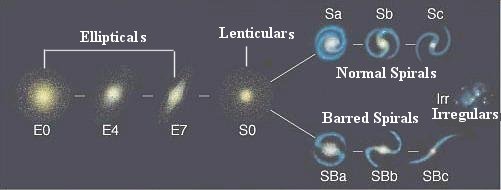
Figure 1. Hubble classification of galaxies.
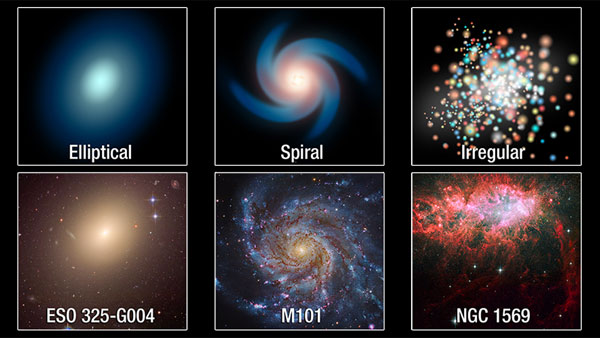
Figure 2. A comparison of the three main types of galaxies (top) with actual photos of galaxies (bottom) that fit the categories.
Various schemes have been devised to bring order to the galactic zoo by pigeonholing galaxies according to one or more properties, including shape, spectrum, and luminosity. A few are listed below but there are many others, including ones that specialize in radio galaxies or unusual systems.
Hubble classification of galaxies
The best known and most often used general scheme, in which galaxies are grouped according to their appearance. Devised by Edwin Hubble, it splits galaxies into ellipticals, spirals (normal and barred), and irregulars, and is represented by the familiar tuning-fork diagram (Figure 1). Elliptical galaxies are graded from E0 (spherical) to E7 (very elongated) in terms of increasing eccentricity). Normal spirals range from Sa (arms tightly wound around the nucleus) to Sc (arms widely spread from the nucleus), and, similarly, barred spirals from SBa (arms tightly wound) to SBc (arms widely spaced). Irregulars are designated Ir. To this original scheme, Alan Sandage added another category, S0, to describe lenticular systems with a nucleus surrounded by a disk-like structure that lacks spiral arms. Galaxies are often said to be "early" (E and S0) or "late" (Sb,Sc, Irr) in type, a remnant of early notions that galaxies physically evolve along the Hubble sequence. Unfortunately, this nomenclature is opposite to that of the dominant stellar population in these types, and to the early-late nomenclature in the Yerkes classification.
Morgan classification of galaxies
A scheme invented by William Morgan that uses the integrated spectrum of the stars of a galaxy together with its shape (real and apparent) and its degree of central concentration. It specifies the galactic spectral type, a, af, f, fg, g, gk, or k (corresponding to the integrated stellar types); the form, type S (spiral), B (barred spiral), E (elliptical), I (irregular), Ep (elliptical with dust absorption), D (rotational symmetry without pronounced spiral or elliptical structure), L (low surface brightness), or N (small bright nucleus); and the inclination to the line of sight, from 1 (face-on) to 7 (edge-on). For example, the Andromeda Galaxy is classified as kS5.
de Vaucouleurs-Sandage classification of spiral galaxies
SA (ordinary spirals), SB (barred spirals): then in parentheses a lower case s (for S-shaped spirals) or r (for the ringed type). Finally, several transitional stages have been added between the SA or SB spirals and the Magellanic irregulars Im. In this classification, the Andromeda Galaxy is SA(s)b.
DDO (or van den Bergh) classification of galaxies
This contains two parameters: (1) the galactic type (Sa, Sb, Sc, Ir) and (2) the luminosity class (I, II, III, IV, V), similar to the MKK system of stellar luminosity class. The notations S- and S+ are used to denote subgiant species with low and high resolution, respectively. The notation S(B) has been introduced to denote objects intermediate between true spirals and barred spirals.

