
Small Magellanic Cloud
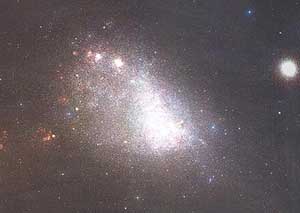
The Small Magellanic Cloud (SMC) is the lesser of the two Magellanic Clouds – irregular galaxies that are satellites of our own Milky Way Galaxy. The Small Magellanic Cloud (SMC) is about 10,000 light-years in diameter, has a visible mass of about one-fiftieth that of the Milky Way, and, at a distance of some 210,000 light-years, is the third-nearest external galaxy after the Sagittarius Dwarf Elliptical Galaxy and the Large Magellanic Cloud (LMC). It is visible to the naked eye in the southern constellation Tucana.
The SMC contains fewer clusters and nebulae than does the LMC, and relatively more gas and dust. However, like the LMC, it seems to have experienced one burst of star formation early in its history followed by a second much more recently. The SMC is important historically as the location in which Henrietta Leavitt discovered the period-luminosity relation of Cepheid variables.

