Chandra X-ray Observatory
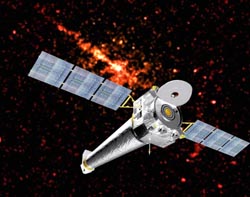
The Chandra X-ray Observatory is one of NASA's four Great Observatories. After being launched by the Space Shuttle Columbia in 1999, Chandra was boosted into a high elliptical orbit from which it can make long duration, uninterrupted measurements of X-ray sources in the universe. It uses the most sensitive X-ray telescope ever built, consisting of four pairs of nearly cylindrical mirrors with diameters of 0.68–1.4 meters, to observe X-rays in the energy range 0.1–10 keV. These mirrors focus X-rays on to two of Chandra's four science instruments: the High Resolution Camera and the CCD (charge-coupled device) Imaging Spectrometer.
International participants in the mission include Britain, Germany, and the Netherlands. The Smithsonian Astrophysical Observatory (SAO) in Cambridge, Massachusetts, is responsible for day-to-day flight operations and science activities from the Operations Control Center and Chandra X-ray Center (CXC) facilities. Known before launch as the Advanced X-ray Astrophysics Facility (AXAF), the observatory was renamed in honor of the distinguished Indian-American astrophysicist Subrahmanyan Chandrasekhar.
| shuttle deployment | Jul 23, 1999 |
| shuttle mission | STS-93 |
| orbit | 10,157 × 138,672km × 29.0° |
| length | 12.2m |
Reference
1. Tucker, Wllace H., and Karen Tucker. Revealing the Universe: The Making of the Chandra X-Ray Observatory. New York: Harvard University Press, 2001.