
Chiron
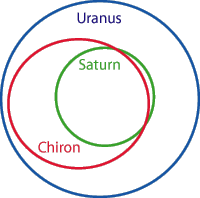
Chiron is an object, discovered by the American astronomer Charles Thomas Kowal (1940–) in 1977, that was originally classified as an asteroid but is now considered to be a Centaur or a weakly active comet (95P/Chiron); its eccentric orbit brings it within the orbit of Saturn at perihelion and almost as far away as the orbit of Uranus at aphelion. Its cometary status was suspected following the 1989 discovery of a dusty coma and confirmed in 1991 by the detection of cyanogen (CN) radicals, a known constituent of cometary gas comas. Because Chiron moves in a chaotic, planet-crossing orbit, it is likely in time to collide with a planet or be permanently ejected from the Solar System.
| diameter | 180 km |
| spectral class | B |
| rotational period | 5.9 hours |
| semimajor axis | 13.63 AU |
| perihelion | 8.43 AU |
| aphelion | 18.8 AU |
| eccentricity | 0.380 |
| inclination | 6.94° |
| period | 50.7 years |
Mythology
In Greek mythology, Chiron (or Cheiron) was the most famous of the Centaurs, son of Cronos and Philyra, and husband of Naïs and Chariclo. He lived in Pelion, and was famous for his skill in healing, hunting, music, and prophecy. Achilles and other heroes were his pupils. He died by being accidentally wounded by one of the poisoned arrows of his friend Hercules.

