Crab Nebula (M1, NGC 1952)

Crab Nebula. This image combines 24 individual exposures obtained with the Hubble Space Telescopes's Wide Field Planetary Camera 2 in 1999 and 2000. Images were taken through different color filters, each revealing different elements. Blue indicates neutral oxygen, green shows singly ionized sulfur, and red comes from doubly ionized oxygen. Credit: NASA, ESA and Allison Loll / Jeff Hester (Arizona State University).

Location in the Milky Way of historic supernovas. This artist's impression shows a view looking down on the Milky Way Galaxy. The position of the Sun is shown, as are the approximate positions and names of historical supernovas, including the Crab Nebula. These are stellar explosions that are thought to have occurred in the last 2,000 years and may have been seen by early astronomers. Credit: NASA/CXC/M.Weiss.
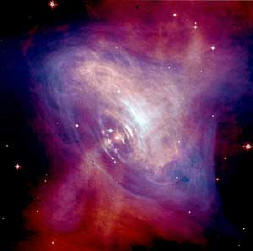
An image of the inner region of the Crab Nebula around the central pulsar produced by combining observations from the Hubble Space Telescope and the Chandra X-ray Observatory in 2000 and 2001.
The Crab Nebula (M1, NGC 1952) is the most famous and conspicuous supernova remnant. It is the centuries-old wreckage of a stellar explosion, or supernova, first noted by Chinese astronomers on 4 July 1054, and that reached a peak magnitude of -6 (about four times brighter than Venus). According to the Chinese records, it was visible in daylight for 23 days and in the night sky to the unaided eye for 653 days. Petroglyphs found in Navaho Canyon and White Mesa (both Arizona) and in the Chaco Canyon National Park (New Mexico) appear to be depictions of the event by Anasazi Indian artists.
The Crab Nebula lies about 6,300 light-years away in the constellation Taurus, measures roughly 10 light-years across, and is expanding at an average speed of 1,800 kilometers per second (some 0.2 arcsecond per year). Surprisingly, its expansion rate seems to be accelerating, driven by radiation from the central pulsar. Its luminosity at visible wavelengths exceeds 1,000 times that of the Sun and comes from two major contributions, revealed spectroscopically by Roscoe Frank Sanford in 1919 and confirmed photographically by Walter Baade and Rudolph Minkowski in 1930. First, a reddish component, with an emission line spectrum like that of emission nebula, forms a far-flung chaotic web of bright filaments. Second, a bluish component, with a continuous spectrum due to highly polarized synchrotron radiation, supplies a diffuse background in the central region of the Crab. This synchrotron component is emitted by high-speed electrons spiraling in a strong magnetic field.
The Crab in radio waves and X-rays
In 1948, the Crab was identified as a strong source of radio waves, and catalogued as Taurus A and, later, as 3C 144. In 1964, it was also found to be a bright X-ray source (Taurus X-1), emitting 100 times more energy in X-rays than it does an optical wavelengths. The collapsed remnant of the star that produced the nebula, the Crab pulsar, was first detected in 1968.
History of observations
The Crab Nebula was discovered in 1731 by the British physician and amateur astronomer John Bevis (1695–1771) according to Charles Messier, who independently found it on 28 August 1758, and first thought it was a comet, when looking for Halley's Comet on its first predicted return. It inspired Messier to begin his famous catalogue and formed its first entry, M1. It was christened the "Crab" on the basis of a drawing made by the Earl of Rosse (William Parsons) in about 1844. The first photo of M1 was obtained in 1892 and the first serious investigation of its spectrum was carried out in 1913–1915 by Vesto Slipher.
See it for yourself
The Crab can be found starting from Zeta Tauri, a third-magnitude star ENE of Aldebaran. Lying about 1° N and 1° W of Zeta, the Crab is visible as a dim patch in 7 × 50 or 10 × 50 binoculars. With more magnification, it is seen as a nebulous oval patch, surrounded by haze. In telescopes larger than 10 cm in aperture, some detail in its shape becomes apparent, with the suggestion of mottled or streaky structure in the inner part of the nebula.
Crab pulsar (PSR 0531+21, NP0532)
The pulsar associated with the Crab Nebula has a period of 33.085 milliseconds, corresponding to a spin rate of 30 revolutions per second, and is one of the few pulsars detected at optical wavelengths. It was discovered, on 9 November 1968, as a pulsating radio source by astronomers at the Arecibo Observatory, and later observed to be flashing at visible wavelengths by observers at Steward Observatory. As an optical pulsar it is sometimes also referred to by the Crab's variable star designation, CM Tauri. At visible wavelengths it shines about as brightly as the Sun – despite the fact that it is measures less than 30 km across.