
core, planetary
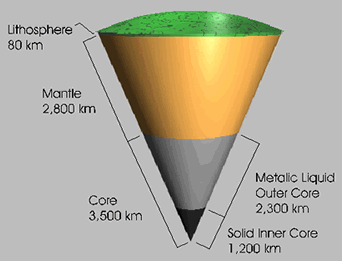
Cross-section of Earth with lithosphere, mantle, and core. Image from John Lahr, USGS Open-File Report 99-132.
The core is the central part of a planet, large moon, or large asteroid that is denser than, and compositionally distinct from, the layers that surround it. Earth has a solid inner core with a radius of about 1,300 kilometers below a fluid outer core some 2,300 kilometers thick. Both regions of the core consist largely of iron and nickel that sank to the center of the planet while it was still molten. Circulating currents in the core give rise to Earth's magnetic field.
The inner and outer core make up about 15% of Earth by volume and 32% by mass. The outer core extends to the Gutenberg discontinuity, the border between the mantle and the outer core. The pressures within the inner core reach about 3 million atmospheres; temperatures are in the range 4,000–5,000°C (7,200–9,000°F). The heat comes from the radioactive decay of uranium.

