mantle
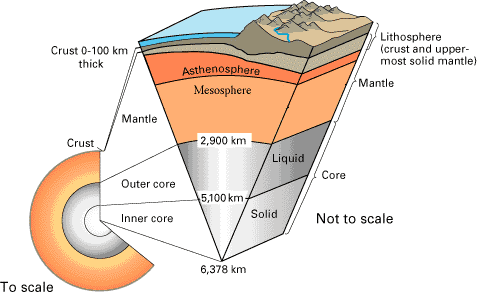
The mantle generally forms the main bulk of a rocky planet or large moon, lying between the crust and the core and differing in composition from both. Earth's mantle extends from about 7 kilometers (beneath the continents) or 30 kilometers (beneath the oceans) to a depth of 2,900 kilometers (1,800 miles) below the surface. It makes up about 84% of the Earth by volume and 67% by mass, and consists of silica, plus iron-, magnesium-, and other metal-rich minerals.
Several distinct parts of the mantle have been recognized. The uppermost part is rigid, solid, and brittle and together with Earth's crust forms the lithosphere. The upper mantle also has a soft zone, which is called the asthenosphere. Temperature and pressure are in delicate balance, so that much of the mantle is near melting point, or partially melted and capable of flowing. Recent studies have suggested this layer is responsible for the production of basaltic magmas. The remainder of the mantle is thought to be more solid, but still capable of creeping flow. In the lower mantle, several changes in seismic velocity can be detected, interpreted as phase changes, in which the atomic packing is rearranged into denser and more complex units.
The Gutenberg discontinuity separates Earth's mantle from the outer core; the Mohorovicic discontinuity separates the uppermost portion of the mantle from the crust.