
ETS (Engineering Test Satellite)
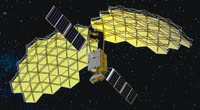
Artist's concept of ETS-8 in orbit.
The ETS (Engineering Test Satellite) series were satellites launched by Japan's NASDA (National Space Development Agency) to demonstrate new spacecraft techniques and test new equipment and launch vehicles. They are also known by the national name Kiku ("chrysanthemum").
ETS-7 consisted of two spacecraft – a chase satellite (Hikoboshi) and a target satellite (Orihime) – which carried out experiments in remote-controlled rendezvous-docking and space robotics. ETS-8, scheduled for launch in 2006, will be the world's largest satellite in geostationary orbit. Among other things, it will test multimedia broadcast systems and carry a high-accuracy atomic clock to test its positioning systems using GPS (Global Positioning System) data.
| spacecraft | launch date | launch vehicle | launch site | orbit | mass (kg) |
| ETS-1 | Sep 9, 1975 | N-1 | Tanegashima | 975 × 1,103 km × 47° | 85 |
| ETS-2 | Feb.23, 1977 | N-1 | Tanegashima | 35,854 × 35,860 km × 12° | 130 |
| ETS-3 | Feb 11, 1981 | N-2 | Tanegashima | 240 × 20,680 km × 28° | 640 |
| ETS-4 | Sep 3, 1982 | N-1 | Tanegashima | 966 × 1,226 km × 45° | 385 |
| ETS-5 | Aug 27, 1987 | H-1 | Tanegashima | 35,770 × 35,805 km × 2° | 550 |
| ETS-6 | Aug 28, 1994 | H-2 | Tanegashima | failed to reach GSO | 3,800 |
| ETS-7 | Nov 28, 1997 | H-2 | Tanegashima | 550 km × 35° | 2,860 |

