
Earth impact craters
Large meteorites and asteroids occasionally strike Earth, as they do other worlds in the Solar System, and create impact craters. However, intense erosion and tectonic processes on our planet quickly (on geological timescales) take their toll of these structures, wiping out all traces of them. Of those of which visible evidence remains, the best-known, best-preserved, and mostly recently-formed is the Barringer Crater. The largest, and one of the most important in terms of its biological effects, is the Chicxulub Crater. Some others are described below. See also astrobleme.
Aorounga Craters
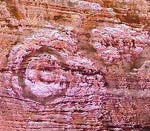 |
A group of three impact craters formed about 360 million years ago in the Sahara Desert in northern Chad at 19° 6' N, 19° 15' E. The first to be found, the 17-meter-wide crater now known as Aorounga South, had been buried by sediments, which were then partially eroded to reveal the current ring-like structure. Two further circular features, both about 16 kilometers across, known as Aorounga North and Aorounga Central, were detected in radar images taken from the Space Shuttle in 1994. The Aorounga craters are only the second suspected crater chain known on Earth; the first consists of eight round depressions, 3 to 17 kilometers wide, stretching along a 700-kilometer line from southern Illinois to Kansas.
Bosumtwi Crater
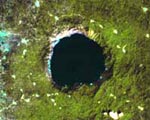 |
An impact crater, 10.5 kilometers in diameter and about 1.3 million years old, located in Ghana in crystalline bedrocks of the West African Shield (6° 32' N, 1° 25' W); it is almost entirely filled by Lake Bosumtwi. Chemical, isotopic, and age studies show that the crater is the most probable source of the Ivory Coast tektites, which are found on land in central Africa and as microtektites in nearby ocean sediments.
Clearwater Lakes Craters
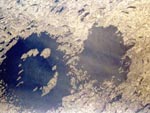 |
Twin, lake-filled impact craters in crystalline bedrocks of the Canadian shield in Quebec; they were formed simultaneously, about 290 million years ago, by two separate but probably related meteorite impacts. The larger crater, Clearwater Lake West (56° 13' N, 74° 30' W), with a diameter of 32 kilometers, has a prominent ring of islands some 10 kilometers across. These islands comprise a central uplifted area and are covered with impact melts. The central peak of the 22-kilometer-wide Clearwater Lake East (56° 05' N, 74° 07' W) is underwater.
Deep Bay Crater
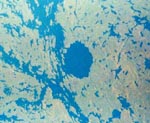 |
An impact crater in Saskatchewan, Canada (56° 24' N, 102° 59' W), formed about 100 million years ago in Precambrian metamorphic crystalline rocks, that is visible as a near-circular bay, about 5 kilometers wide and 220 meters deep, in the otherwise shallow Reindeer Lake. The circular shoreline, at a diameter of 11 kilometers, is partially surrounded by a ridge with heights to 100 meters above the lake surface. The diameter of this ridge, about 13 kilometers, is likely the outer rim of the impact structure. Although not obvious from the surface, Deep Bay is a complex impact structure with a low, totally submerged central uplift.
Kara-Kul Crater
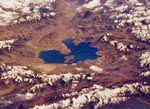 |
A spectacular impact crater, partly filled by the 25-kilometer diameter Kara-Kul Lake, almost 6,000 meters above sea-level in the Pamir Mountain Range in Tajikstan, near the Afghan border (38° 57' N, 73° 24' E). The crater, whose rim has a diameter of 45 kilometers, was formed less than 10 million years ago.
Manicouagan Impact Structure
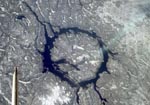 |
One of the largest preserved impact craters on Earth, located in Quebec, Canada, at 51° 23' N, 68° 42' W; it was formed about 212 million years ago. An ice-covered annular lake, 70 kilometers across, now lies within a ring of rock showing clear signs of having been melted and altered by a violent collision. The original rim of the crater, though now eroded away, is thought to have had a diameter of about 100 kilometers.
Wolfe Creek Crater
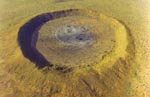 |
A relatively well-preserved meteorite crater, thought to be about 300,000 years old, that is partly buried under wind-blown sand in the flat desert plains of north-central Australia at 19° 10' 19" S, 127° 47' 42" E. Its rim is 875 meters in diameter and rises 25 meters above the surrounding plains and 75 meters above the crater floor. Oxidized remnants of iron meteoritic material, as well as some impact glass, have been found in the vicinity.

