
Precambrian
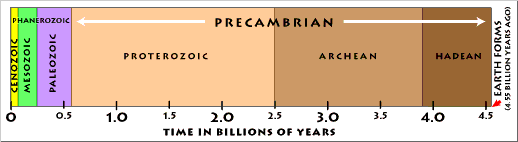
The Precambrian was the earliest and longest period of geologic time, extending from the formation of Earth (4.5 billion years ago) to about 543 million years ago when the Paleozoic era began. The Precambrian accounts for about 90% of geologic time. It has been divided according to several different systems, all of which use the presence or absence of evidence of life as a criterion. According to one of these systems, the Precambrian is divided into three eras: the Hadean, Archean, and Proterozoic.
During the Precambrian, some of the most important events in biological history took place: life arose, the first tectonic plates were formed and began to move, eukaryotic cells evolved, the atmosphere became enriched in oxygen, and just before the end of the Precambrian, complex multicellular organisms, including the first animals, evolved. See also Phanerozoic.

