
eukaryotic cell
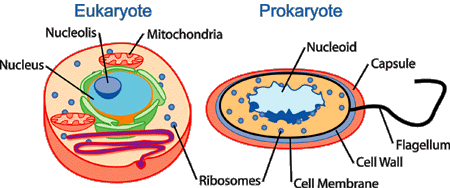
Figure 1. Comparison of a typical eukaryotic cell with a typical prokaryotic cell (bacterium). The drawing on the left highlights the internal structures of eukaryotic cells, including the nucleus (light blue), the nucleolus (intermediate blue), mitochondria (orange), and ribosomes (dark blue). The drawing on the right demonstrates how bacterial DNA is housed in a structure called the nucleoid (very light blue), as well as other structures normally found in a prokaryotic cell, including the cell membrane (black), the cell wall (intermediate blue), the capsule (orange), ribosomes (dark blue), and a flagellum (also black).
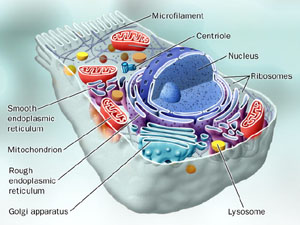
Figure 2. A typical eukaryotic cell.
A eukaryotic cell is a cell that contains membrane-bound compartments in which specific metabolic activities take place. Most important among these compartments is the nucleus, which houses the eukaryotic cell's DNA. It is this nucleus that gives the eukaryote – literally, "true nucleus" – its name. Eukaryotic organisms also have other specialized, membrane-bounded structures, called organelles, which are small structures within cells that perform dedicated functions. Eukaryotic cells are typically 10 to 100 micrometers across, or about 10 times the size of prokaryotic cells.
Origin of eukaryotic cells
The set of ideas most favored by biologists to explain how eukaryotic cells first came about is called the endosymbiotic theory. This theory is able to account well for the fact that two of the organelles found in eukaryotic cells, mitochondria and chloroplasts, have their own DNA that is completely distinct from the DNA housed in the nucleus. According to the endosymbiotic theory, the eukaryotic cell evolved from a symbiotic community of prokaryotic cells. Specifically, the mitochondria and the chloroplasts are what remains of ancient symbiotic oxygen-breathing bacteria and cyanobacteria, respectively, whereas the rest of the cell seems to be derived from an ancestral archaean (see archaea) prokaryote cell.
The origin of the eukaryotic cell was a milestone in the evolution of life. Although eukaryotes use the same genetic code and metabolic processes as prokaryotes, their higher level of organizational complexity has permitted the development of truly multicellular organisms. Without eukaryotes, the world would lack mammals, birds, fish, invertebrates, fungi, plants, and complex single-celled organisms.
Structure
All eukaryotic cells have a number of features in common. These include:
However, there are also some important differences between animal cells and plant cells.
| Comparison of eukaryotic and prokaryotic cells | ||
|---|---|---|
| eukaryotic cells | prokaryotic cells | |
| types of organism | Found in "complex" organisms, including all plants and animals | Found in "simple" organisms, including bacteria and cyanobacteria |
| specialization | Can specialize for certain functions, such as absorbing nutrients from food or transmitting nerve impulses; groups cells can form large, multicellular organs and organisms | Usually exist as single, virtually identical cells |
| size | Most animal cells are 10–30 micrometers across; most plant cells are 10–100 micrometers across | Most are 1–10 micrometers across |
| nucleus | Contain a nucleus and many other organelles, each surrounded by a membrane (the nucleus and mitochondrion have two membranes) | Lack a nucleus and other membrane-encased organelles |
| nucleolus | One (or more) present in each nucleus | Absent |
| DNA | DNA always in combination with histone proteins | Simple duplex not associated with histones (i.e. basic proteins)Absent |
| spindle | Present temporarily during mitosis and meiosis | Absent |
| sexual system | Complete nuclear fusion between gametes, with equal contributions from both genomes | Unidirectional transfer of genes from donor to recipient |
| cell wall | Present in plant cells, but never contain muramic acid | Present, but chemically different in many respects from eukaryotes (e.g. presence of muramic acid) |
| internal membranes | Complex compartmentalization into endoplasmic reticulum, Golgi bodies, lysosomes, etc | Usually simple and often transient, if present at all |
| ribosomes | 80 S with subunits (60 S + 40 S) | 70 S* with subunits (30 S + 50 S) |
| photosynthesis | Complex chloroplasts (membrane-bounded organelles) | Simple chromatophores |
| respiration | Virtually all forms are aerobic, though a few are faculatively anaerobic (e.g. yeasts); and, uniquely, the trichomonads are obligate a ne robes | Simple chromatophores |
| electron transport system & ATP synthesis | Found on the inner membrane of special membrane-bound organelles: mitochondria (oxidative phosphorylation) and chloroplasts (photophosphorylation). Virtually all forms are aerobic, though a few are faculatively anaerobic (e.g. yeasts); and, uniquely, the trichomonads are obligate anaerobes | Localized on the cell membrane |

