
endoplasmic reticulum
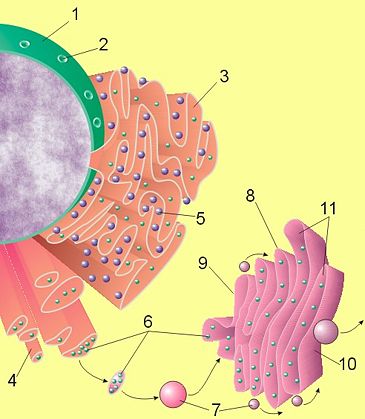
1 Nucleus
2 Nuclear pore
3 Rough endoplasmic reticulum (rER)
4 Smooth endoplasmic reticulum (sER)
5 Ribosome on the rough ER
6 Proteins that are transported
7 Transport vesicle
8 Golgi apparatus
9 Cis face of the Golgi apparatus
10 Trans face of the Golgi apparatus
11 Cisternae of the Golgi apparatus.
The endoplasmic reticulum is an extensive network of membranes in the cell that extends from the cell membrane through the cytoplasm to the nuclear envelope. The membranes of the endoplasmic reticulum (ER) surround an inner cavity called the lumen and enclose a series of tubes and flattened membranous areas. The ER membranes actually attach to the cell membrane and the outer membrane of the nuclear envelope as well as the Golgi apparatus in the cytoplasm. The endoplasmic reticulum often makes up more than 10% of a cell's total volume.
There are two types of ER. Rough ER has large numbers of ribosomes attached to it and is where new proteins are assembled in the cell (see protein translation). Proteins made on the rough ER's ribosomes end up in other organelles or are sent out of the cell to function elsewhere in the body. A few examples of proteins that leave the cell (called secreted proteins) are antibodies, insulin, digestive enzymes, and many hormones. (Proteins made on free-floating ribosomes, by contrast, stay in the cytosol.)
Smooth ER has no ribosomes associated with it and has a very different function: it specializes in synthesizing lipids and also contains enzymes that break down harmful substances. Most cell types have very little smooth ER, but some cells, such as those in the liver, which are responsible for neutralizing toxins – contain lots of it.

