
nuclear envelope
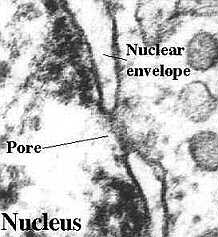
The nuclear envelope is a double-membrane structure that surrounds the nucleus of a eukaryotic cell. The parallel nuclear membranes are separated by a narrow space (40–70 nanometers wide) known as the perinuclear cisterna. The nuclear envelope has many pores in its surface which regulate the flow of macromolecules into and out of the nucleus. Each of the nuclear pores has a diameter of about 70 nanometers (but an effective diameter for transport of only about 10 nanometers) and is enclosed by single layered diaphragm of protein.
The outer membrane of the nuclear envelope is covered with ribosomes and is continuous with the rough endoplasmic reticulum (RER). It reforms the RER after cell division.

